Pros of Living in Nevada
1. No State Income Tax For Those Living in Nevada
Hands down, one of the biggest perks of moving to Nevada is the lack of state income tax. Nevada is one of nine states that doesn’t have a state income tax, which means you get to keep more of your paycheck.
This is a huge perk that can’t be overstated. For reference, the neighboring state of California has a state income tax of (up to) 13.3%, depending on your income bracket. Think about that! Simply by living in Nevada vs California, you get to keep up to 13% more of your paycheck.
Likewise, Nevada also has the some of the lowest property taxes in the country (huge perk for those planning on buying a home when moving to Nevada). All told, the overall tax burden of living in Nevada is quite low. In fact, Nevada has one of the lowest overall tax burdens in the country. With such a low tax burden, is it any wonder why so many folks end up retiring in Nevada?
2. Constant Sunshine
If you’re moving to Nevada for the sake of sunshine, you won’t be disappointed. Nevada is considered one of the sunniest states in the country.
Nevada averages 210 days of sunshine per year, which means you’ll get your fill of Vitamin D most days of the year. The climate tends to be arid and warm, which takes some adjustment for those moving to Nevada from muggier climates.
But I don’t want to fool you — it’s not all sunshine and rainbows when it comes to living in Nevada. Far from it, we’ll cover the downside of Nevada’s dry climate in the cons section below.

3. Nevada Is A Mountainous State
Somethings folks don’t realize until living in Nevada is that it’s one of the most mountainous states in the country. This comes as a surprise for most folks because the states is associated mostly with the desert. But it’s true, home to 2,100+ mountains, you can easily find some stunners.
One of the top sports my friends are into is rock climbing, something I didn’t understand until realizing our proximity to the mountains. Another popular activity is mountain biking — you’ll have an opportunity to learn both while living in Nevada!
Fun fact: With an impressive elevation of 13,147 feet, the highest peak in Nevada is Boundary Peak.
4. Outdoor Recreation Opportunities
Going hand in had with the mountains, living in Nevada is a treat for those that love the outdoors. There’s so many great national parks and forests to play in, you’ll never have a reason to be bored. If helpful, here’s a roundup of the most popular outdoor spots:
Lake Tahoe
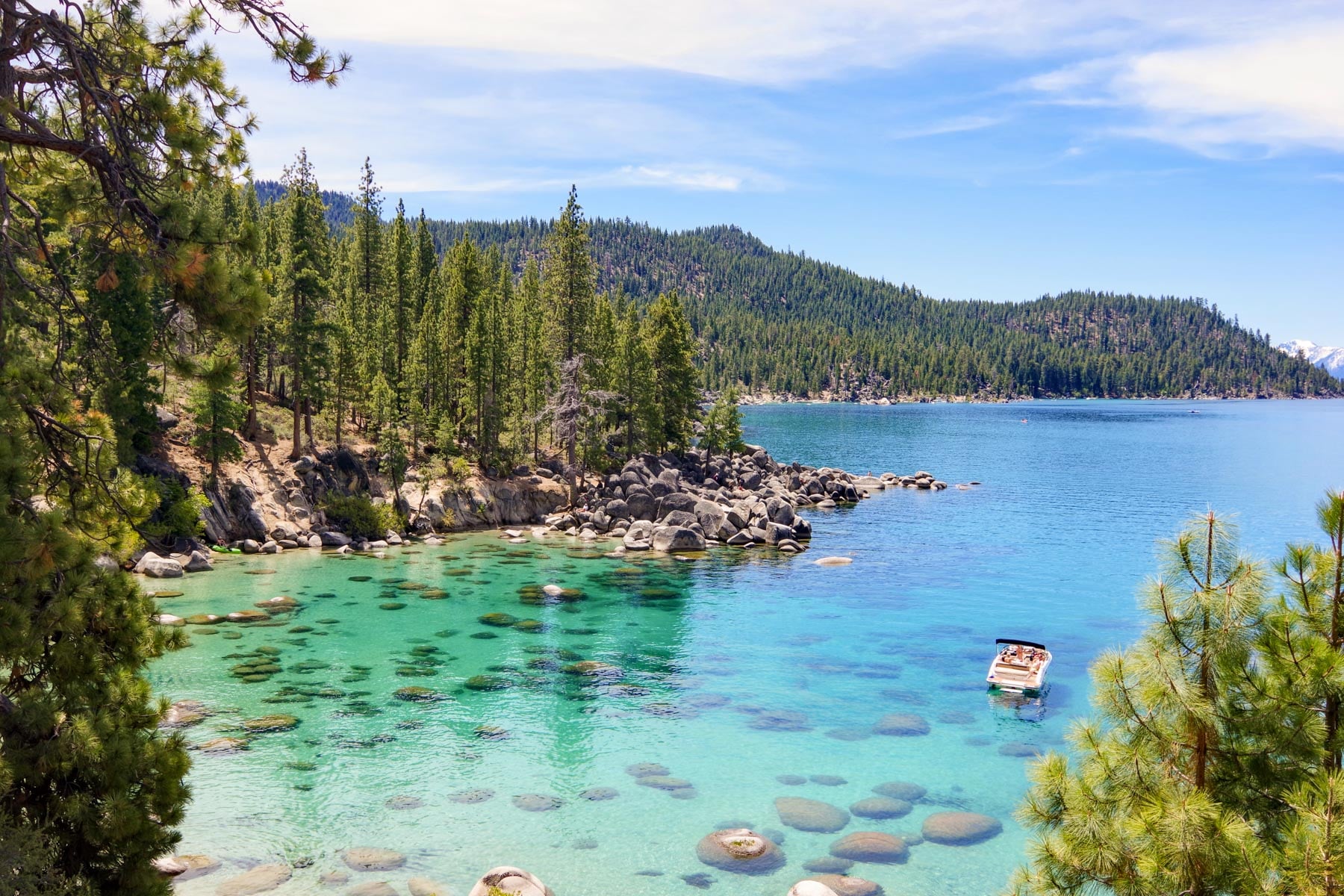
Having easy access to Lake Tahoe is a huge perk of living in Nevada. Straddling the border of California and Nevada, Lake Tahoe is the largest alpine lake in the country, and is often considered the most beautiful.
Spanning 22 miles, the pristine shades of blue entice swimmers to plunge into the chilly clear waters of this fresh water lake. But fair warning: Don’t expect to find much solitude here, Lake Tahoe is one of the most visited spots in Nevada.
Great Basin National Park
Great Basin National Park is one of the least visited national parks, a fact that boggles my mind because the park is a joy to explore. The hiking opportunities are endless, the old growth Bristle Cone Pine trees are guaranteed to impress and the solitude is priceless.
Lake Mead
Located 24 miles east of Las Vegas, Lake Mead is the largest reservoir in the US based on water capacity. The reservoir formed by the Hoover Dam and attracts locals and visitors alike in hordes. Popular things to do include hiking, fishing and boating.
But take note — the water levels at Lake Mead are declining drastically and there’s no telling if they will ever recover. I don’t mean to be a downer, but this is an honest list and you’ll hear other locals sharing concerns about Lake Mead after moving to Nevada.

5. Capital of Gaming & Entertainment
No list of the pros and cons of living in Nevada is complete without mentioning the endless gaming and entertainment experiences at your fingertips. If you’re moving to Nevada’s most populous city, Las Vegas, you’ll be spoiled for choice when it comes to food and entertainment. Vegas is known as the gambling capital of the world. You’ll have access to luxury casinos, vibrant nightlife, world-class performances and incredible restaurants.
With access to so much entertainment a regular question folks ask is if moving to Nevada is right for them. Well, there’s a few things to consider, mainly:
- Sports and casino gambling is legal
- Prostitution is legal in certain counties
All told, your comfort level of living in Nevada, especially Sin City, is dependent on you. If you’re a party animal, you’ll love it. But if you’re more reserved you may find the lifestyle annoying, but you don’t have to participate unless you want to. By avoid the main strip, you’ll be just fine (and Reno may be a better option for you).
6. Nevada is Diverse
A lot of folks don’t realize that Nevada is one of the 9th most diverse state in the nation. The state ranks highly for racial/ethnic diversity, with almost 30% of the population identifying as Hispanic and 10% identifying as Black or African American. Another interesting fact about living in Nevada is that folks born in state make up 26.7% of the population, which is the lowest rate in the United States. In other words, native-born residents are considered the minority.
Fun fact: Nevada is the state where you are most likely to meet a transplant.
Likewise, a high percentage of folks end up moving to Nevada for retirement, which only adds to the diversity. Nevada is one of the top 10 states in the country for retirees. So if you’re moving to Nevada with the hopes of expanding your social circle, you’ll have an opportunity to do so.

7. Mild Winters Are a Huge Perk of Living in Nevada
If you’ve lived through your fair share of brutal winters, you’ll find some respite in Nevada. The summers are brutal (I’ll cover this shortly) but the winters are perfectly mild and sunny. Average winter temperatures hover around 50-60 degrees and it doesn’t rain very often (average statewide rainfall clocks in at 10 inches).
Which means you can easily grill out in December while living in Nevada. How many folks can host BBQs in the dead of winter? Not very many — all the more reasons why moving to Nevada is so appealing to folks. The best part? If you’re into snow sports you can still have your fill of snowboarding, snowshoeing and skiing in the mountains nearby. You’re never more than two hours away for a heart-thumping snow-centric activity while living in Nevada.
- $480k−1.8%FRED / realtor.com · 2026-0933rd cheapest of 50 states
- $441k−0.1%Zillow Home Value Index (state) · 2026-0936th cheapest of 50 states
- 4.7%−0.1 ptBLS Local Area Unemployment Statistics · 2026-09tied for 42nd lowest of 50 states
- $5.30−1.8%AAA · 2026-10-2647th cheapest of 50 states
- 100.0US = 100BEA Regional Price Parities (SARPP) · 2024
Locals’ verdictGrade Nevada on cost, weather, jobs, people and safety · where it stands on our rankings
Cons of Moving to Nevada
1. The Job Market Leaves Much to Be Desired
There’s no reason to sugarcoat it: Nevada’s job market sucks. If I’m being honest, it’s one of the biggest things that prevents me from living in Nevada long-term. The currently unemployment rate is 5.3%, the highest in the country. Likewise, the state’s top employers tend to lean towards entertainment and service industry work:
- Wyn Las Vegas Resort
- Flamingo Las Vegas Hotel
- Las Vegas Police
- MGM Grand
- Clark County School District
This information is not surprising, I know, but it’s worth mention because it shows how limiting job prospects are for those moving to Nevada with a college degree. Don’t expect to find much in fields that cater to those with degrees.

2. The Blazing Hot Temperatures
Alright, this wouldn’t be considered an honest list on the cons of living in Nevada without mentioning the unbearable heat. Summer temperatures while living in Nevada are hard to explain to those that have never visited, but I’ll try.
While most places in the country feel like a miserable swamp during summer (looking at you southern states), Nevada will suck the water out of you in an instant. The lack of humidity partnered with high temperatures is downright dangerous — Nevada has the highest heat-related deaths in the country per capita.
The temperature routinely exceeds 110 degrees during the summer months, staying hydrated is essential to survival.
3. The Dry Heat Takes Adjustment
Nevada is one of the driest states in the country. As a transplant, I can tell you that this place is really, really dry. I went through a hard adjustment period after moving to Nevada that tested my resolve.
My skin cracked easily, my hair changed and I found myself using gallons of lotion on a monthly basis. I bought this exact humidifier within one month of moving to Nevada on the recommendation of a coworker. All told, I’ve really had to adjust my hygiene products to keep up with the dry heat.
But I will say this, the one upside to the deathly dry climate is the of mold. I’m very sensitive to mold and mildew but haven’t had an issue with either since moving to Nevada.
Local’s Tip: One of my coworkers recommends using Vaseline inside your nose to prevent nose bleeds during excessively dry days. You better believe I stock up on the stuff from June to August.

4. Nevada Is One of the Least College Educated States In the Country
With only 25% of households with Bachelor’s degrees (or higher), Nevada is one of the least-college educated states in the nation. Ouch.This one is a huge con of living in Nevada because we’re not attracting top talent and our average salaries prove it. The job market doesn’t cater to college-educated prospects so many folks don’t see the value in a college education.
One of my coworkers said it best: If most of the jobs in the state are found in entertainment, how do you convince your kid to go to college, especially if they see themselves living in Nevada long-term? That’s a hard question to answer, but a good one to consider. If you’re moving to Nevada with kids in tow, know that the public school system won’t necessarily set your kid up for success after high school graduation.
Speaking of public education in Nevada, let’s dive into that can of worms next.
5. Poor Public Schools
The public schools in Nevada often ranks as some of the worst in the country. In regular speech — the education system here is a joke. So much so, that I would urge families moving to Nevada to strongly reconsider unless paying for private school is an often. Between lower than average standardized test scores and low graduation rate of 81%, the schools in Nevada are nothing to write home about (unless you’re writing to complain).
Good to know before moving to Nevada: In 2018, Nevada’s education system was rated worst in America.

6. Lack of Decent Healthcare
The lack of decent healthcare is something everyone should strongly consider before moving to Nevada. Whether you plan on having children or are moving to Nevada to retire, chances are you’ll need a good doctor. Unfortunately for you, Nevada’s access to quality healthcare is some of the worst in the country. Medical malpractice lawsuits are far too common so the state doesn’t attract top doctors.
7. High Rates of Homelessness
If you recall that I mentioned Nevada is one of the least populous states in the country, so this may surprise you: Nevada has some of the highest homeless rates in the nation to boot. In fact, .22% of the population is considered homeless (8th highest rate in the United States).
You’re bound to see homeless folks in the metro areas while living in Nevada (especially Las Vegas). I’m the first to admit that I don’t know what the solution to homelessness is, so I don’t know how much I can contribute to the conversation — I just want to be transparent with you.
8. Know About the Washoe Zephyr
The Washoe Zephyr is worth knowing about for those considering moving to Nevada. Locals know this all to well, but it seems to catch newcomers by surprise. Don’t worry, I won’t let that happen to you. The Washoe Zephyr (Washoe is a nickname for Nevada) is a seasonal daily wind that occurs in the western part of the state (east of the Sierra Nevada mountains). The wind blows primarily during the summer months and is strong enough to knock you off your feet.
On days the wind blows you’ll be stuck indoors — which isn’t the end of the world when you consider those dizzying summer temps, but still worth mention. This is a scientific thing and I don’t have the ability to explain it adequately. If helpful, here’s a great explanation.
Tell the next person the thing the guide misses.
FAQ – Living in Nevada
If you’re okay with soaring temperatures and dry heat, you’ll find life in Nevada enjoyable. The world-class entertainment is guaranteed to impress you for years and the outdoor recreational opportunities are endless. However, if you find it hard to adjust to arid climates, you will find living in Nevada challenging.
Yes, Nevada is a great place to retire. If you choose to retire in Nevada, you’ll be amongst like-minded thinkers. Nevada is the 6th most popular state in the country for retirees. But between the constant sunshine and low tax burden, it’s not hard to see why people love retiring in Nevada.
A common question I get asked is what’s it like living in Nevada vs. California. The two states are vastly different in terms of politics and taxes. Nevada is the cheaper option of the two because it has one of the lowest tax burdens in the country. Likewise, Nevada is one of the least populous states in the country, where California is the most populous. You’ll find epic outdoor recreation in both states, although the topography is more varied in California. If you’re searching for a slower pace of life and more affordability, living in Nevada vs. California is a safe bet.
Yes, as of 2017, the purchase and possession of marijuana is legal in Nevada. Recreation use is permitted.
Nevada averages 210 days of sunshine per year, making it one of the sunniest states in the country.
Pros & Cons of Moving to Nevada (Post Summary)
In sum, here’s a quick roundup of the pros and cons of living in Nevada.
- No state income tax while living in Nevada
- Constant sunshine
- Nevada is a mountainous state
- Outdoor recreation opportunities
- Capital of gaming & entertainment
- Nevada is diverse
- Mild winters are a huge perk of living in Nevada
- The job market leaves much to be desired
- The blazing hot temperatures
- The dry heat will take adjustment (bloody noses)
- One of the least college educated state in the USA
- Poor public schools
- Lack of decent healthcare
- High rates of homelessness
- Know about the Washoe Zephyr
Compare the Pros vs the Cons of Living in Nevada
| Pros of Living in Nevada | Cons of Moving to Nevada |
|---|---|
| No state income tax while living in Nevada | The job market leaves much to be desired |
| Constant sunshine | The blazing hot temperatures |
| Nevada is a mountainous state | The dry heat will take adjustment (bloody noses) |
| Outdoor recreation opportunities | One of the least college educated state in the USA |
| Capital of gaming & entertainment | Poor public schools |
| Nevada is diverse | Lack of decent healthcare |
| Mild winters are a huge perk of living in Nevada | High rates of homelessness |
| Know about the Washoe Zephyr |
Pin Living in Nevada


Helpful Nearby Perspectives
Living in Las Vegas: 15 Honest Pros & Cons of Living in Las Vegas
Living in Arizona: 20 Honest Pros & Cons of Living in Arizona
Living in Tucson: 20 Honest Pros & Cons of Living in Tucson
Living in Phoenix: 15 Honest Pros & Cons of Living in Phoenix
Living in New Mexico: 22 Honest Pros & Cons of Living in New Mexico
Living in Nevada: 15 Honest Pros & Cons of Living in Nevada
Living in Utah: 15 Honest Pros & Cons of Living in Utah
Living in California: 20 Honest Pros & Cons of Living in California
What 2026 Changed
Update from The Honest Local, September 2026: everything from here down was added after the original local wrote this guide, with a source for each figure.
Lake Mead set a record low on August 31, 2026. Nevada’s other numbers shifted too, but that is the one that shapes the rest.
- Lake Mead hit a new record low. On August 31, 2026 the lake sat at 1,038.83 feet, below the 2022 record and roughly 18 feet lower than a year earlier (Bureau of Reclamation). Reclamation cut Lake Powell’s release to 6.0 million acre-feet for the water year because inflow ran about 36% of average. The bathtub ring is not a metaphor anymore.
- Nevada’s rate was 5.0% in July 2026 against 4.1% nationally (BLS). That is still near the bottom, but Washington DC (5.9%), Connecticut and Oregon (5.2%) are now worse.
- Vegas tourism flattened. Las Vegas drew 38.5 million visitors in 2025, and through July 2026 visitor volume was up just 0.5% while airport passengers were down 6.9% (LVCVA, July 2026 summary). Hotels still ran 77.2% full at a $157 average rate. Fewer people, paying more.
- Housing stopped sprinting. The median listing price was $469,900 in the Las Vegas metro and $675,000 in the Reno metro in July 2026 (Realtor.com data via FRED). Statewide, $480,000Median listing price, realtor.com via FRED, September 2026. Updates itself when the source does. as of September 2026. High, but not climbing the way it did in 2021 and 2022.
- Every Strip casino is union now. In August 2025 Local 226, the Strip’s hospitality union, announced contracts at every major Strip casino hotel for the first time, including the Venetian and Fontainebleau. If you are coming for a hospitality job, that matters for your paycheck.
- Fire season came to Reno. The Fred Mountain Fire started near Reno on August 11, 2026 and merged with the Bug Fire. Smoke days are part of northern Nevada summers now.
Cost of Living in Nevada
Nevada runs about 5% pricier than the country as a whole. BEA scores Nevada housing at 114.1Housing (BEA price parity for housing services, priced from what tenants pay in rent), the Bureau of Economic Analysis, 2024. Updates itself when the source does., 14 points over the national figure, while goods come in at 96.3Goods prices (BEA price parity), the Bureau of Economic Analysis, 2024. Updates itself when the source does., so the stuff you buy is a hair cheaper here and the roof over it is not.
Housing is the whole story. Zillow’s typical home value for the state is $440,739Typical home value, Zillow, September 2026. Nevada. Updates itself when the source does. as of September 2026, against $366,157Typical home value, United States, Zillow, September 2026. Updates itself when the source does. nationally, so you’re paying about 20% over the US for a house. Asking prices say the same thing. Realtor.com’s median listing is $480,000Median listing price, realtor.com via FRED, September 2026. Updates itself when the source does. here and $419,250Median listing price, United States, realtor.com via FRED, September 2026. Updates itself when the source does. nationally, 15% over. The typical renter household hands over 33.1% of its income to the landlord (Census, 2020 to 2024), three points past the line where the housing people start using the word burdened. Nobody moves here for the rent.
The rest of the monthly bill. Regular gas is $5.30Regular gas, AAA, October 26, 2026. Updates itself when the source does. (AAA), the 4th-priciest of the 50 states we track, which is to say almost everyone else pays less. Electricity is the consolation. Residential power ran 12.77 cents a kilowatt hour in July 2026 against 18.31 nationally (EIA), so the air conditioning that runs from May to October costs less per hour than the national average. The state sales tax is 6.85% and the average combined rate is 8.24% (Tax Foundation, midyear 2026), but the number you’ll actually pay depends on the county, 8.375% in Clark, 8.265% in Washoe, 7.6% in Carson City, Nye and Churchill, 7.1% in Douglas, Elko and Lyon (Nevada Department of Taxation county rate sheets). Property tax is light, an effective 0.47% of home value with a median annual bill of $2,027 by the Census Bureau’s count (2020 to 2024), or 0.50% by the Tax Foundation’s, and the state caps the yearly increase on your primary home’s bill at 3%. Homeowners insurance averaged $1,876 a year in 2026 against $2,872 nationally (Insurance.com).
Cost of living by city in Nevada
Las Vegas, Reno and Carson City are the metros BEA prices, and the rest of the table is the small towns Zillow tracks. The smaller the place, the fewer rental listings Zillow sees, so read the rent column for the small-town rows as a rough guide.
| Metro or town | Typical home | Typical rent | Prices vs US | Unemployment |
|---|---|---|---|---|
| Las Vegas | $424,000 | $1,742 | 100.2 | 5.4% |
| Reno | $570,900 | $2,055 | 101.0 | 4.0% |
| Carson City | $495,400 | $2,039 | 98.1 | 3.9% |
| Gardnerville Ranchos (Minden and Gardnerville) | $701,700 | $2,513 | no BEA figure | 4.1% |
| Fernley | $418,600 | $2,093 | no BEA figure | no BLS figure |
| Fallon | $394,900 | $1,581 | no BEA figure | 4.5% |
| Elko | $370,300 | $1,689 | no BEA figure | 3.4% |
| Pahrump | $357,100 | $1,519 | no BEA figure | 6.5% |
| Winnemucca | $352,400 | no Zillow rent figure | no BEA figure | no BLS figure |
Read that table twice. Of the towns with a jobs figure, Pahrump has the cheapest houses and the highest unemployment. The Gardnerville Ranchos row is Douglas County, the valley under the east side of Tahoe, and it prices like the Bay Area money that moved there. Elko is the sleeper, $370,300 for a house, 3.4% unemployment, and nobody there checks what the Strip is doing.
Best Places to Live in Nevada, by Who You Are
Henderson if you have kids (violent crime 225 per 100,000, about half of Las Vegas Metro’s), Mesquite if you’re retired ($1,297 rent), Las Vegas if you’re in your 20s ($1,712 rent), Carson City if you work from home ($2,113 rent). Homes and rents are Zillow’s city numbers for August 2026, so they won’t match the metro table, crime is the FBI’s 2025 rate for whoever patrols the town, and growth is the Census estimate since 2020.
Families with kids
A $479,300 typical home and $1,806 rent buy you a violent crime rate of 225 per 100,000, about half of what Las Vegas Metro handles across the line at 412. It grew 11.5% since 2020 to 353,289 people, so you won’t be the only new family on the block. Boulder City is the small-town version, 14,884 people who have decided to stay, a $470,800 home, $1,608 rent, and a violent crime rate of 159, which is 24 offenses in the whole of 2025. Up north, Sparks ($535,200, $2,140) runs a violent crime rate of 365 against Reno’s 551 next door. The schools are the schools wherever you land, and the families who make it work here budget for tutoring or private school the way they budget for air conditioning.
Retirees
Mesquite is the retiree town, an hour up I-15 from Las Vegas on the Arizona line, and $1,297 rent with a $373,500 typical home. Violent crime ran 119 per 100,000 in 2025, 29 offenses all year, and it grew 17.3% since 2020 to 24,001 people. Pahrump is the budget pick, $366,100 for a house, $1,512 rent, an hour west of Vegas over the hump, patrolled by the Nye County Sheriff at a violent crime rate of 238.
People in their 20s
Las Vegas, because it’s where the jobs are and the rent is the lower of the two big cities, $1,712 typical against a $419,100 home you’re not buying yet anyway. Reno is the other answer, $1,967 rent, a university, 4.0% unemployment, Tahoe forty minutes up the hill, and a violent crime rate of 551 that is the highest of any city in this section. If you want the Vegas job market and plan to buy soon, North Las Vegas ($402,400, $1,889) grew 14.3% since 2020 to 296,653 people, and a lot of them are you.
Remote workers
You’re the reason the north half of the state got expensive. Carson City ($501,600, $2,113, 3.9% unemployment) is the capital with a small-town main street and Tahoe twenty-five minutes away. Minden and Gardnerville ($707,300 and $612,500) are the Carson Valley. Dayton ($458,200, $2,238) and Fernley ($402,800, $1,988, up 14.5% since 2020 to 26,214 people) are the commuter towns for people who need Reno once a week. Elko ($363,400, $1,788) is four hours from anything and has the lowest unemployment of any area in the table above at 3.4%. And if you have real money, Incline Village on the Nevada shore of Tahoe runs $1,526,800 for a typical house, more than three and a half times Las Vegas, and rents at $4,290.
I love write blog about Nevada, my wife and I lived in Carson City for 18 and a half years and loved living there. We left before the legalization of weed so we did not the changes that made. The wind became a big thing in around 2005 as global warming made it worse! Prior to that it was soo nice in the summer. Employment is a joke, plan to become self employed if your not retired. I lived as a care taker and ran a handyman business for 15 years, NV has some very lenient business lic. Laws in CC area the Capital but they enforce through the court system not the contractors board for non lic. Contractors so people are protected from fraud- never went before a judge for my business! You covered must things well but one thing you left out was Sage Brush! Nevada is covered in it and many who move there are or become allergic to it! If one burns it or a fire happens it stinks and causes breathing problems. Burning it is prohibited! The great fire in CC in 2005 was a tough experience and the Mts burnt way up into the Tahoe basin it stunk for years and 11 homes burnt, could have been worse. One should take that into consideration before moving there, my wife is now very allergic to 2 of the 3 forms of sage brush. I my great memories of living in Nevada and would consider moving back leaving Idaho without thought if not for the cost of living and and her allergies.
Don Schelling, Carson City, in the thread below
Don’s “plan to become self employed if your not retired” is the most Nevada sentence anyone has ever left in this thread, and the sagebrush allergy is real. Ask your allergist before you sign a lease in the north.
Not knowing a soul out here, we moved from the humid southeast to northern NV in 1999 after an exploratory road trip of seven western states. We grew to love Nevada soon after relocating. With its strong Old West vibe, the gentle tax structure, the availability of huge chunks of land at affordable prices, and course the wonderful dry climate, we settled in for 23 years.
While we are not natives, after all those years we shed the newbie label and enjoyed (and endured) nearly everything that Northern Nevada had to offer. One aspect of this area that often overlooked is that it is primarily a cold climate. The months from mid-June to early September stay hot, but once the cold sets in, it stays cold. And windy. Ugh, that wind.
As hot as it gets, I’ve never felt it to be oppressive. At 100 degrees, so long as you are shaded and out of the direct sun, it is not uncomfortable. Sweat evaporates so quickly you barely see it form on your skin. Dry heat, in other words, is comfortable heat. Not everyone likes it, but we sure did.
John Glatthar, 23 years in northern Nevada, in the thread below
John’s “primarily a cold climate” line is the thing nobody tells remote workers pricing Carson Valley off a July visit. Reno sits at 4,500 feet. Buy the snow tires.
Moving to Nevada, the Checklist
The stuff nobody writes about and everybody Googles, mostly the DMV. The rules and fees come from the statute or the agency, checked September 25, 2026, and the links go to the source so you can see if a fee has moved.
- Driver’s license, 30 days. State law gives you 30 days from the day you become a resident to get a Nevada license (NRS 483.245), and the DMV counts you as a resident once you live and work here, make Nevada your car’s home state, or declare it your legal residence, and the license itself needs a Nevada street address, no P.O. boxes. If you’re 21 or older with a current US or Canadian license, the only test is the eye chart. Under 21 adds the written test. Bring one proof of identity, your Social Security number, two proofs of your Nevada address like a lease and a utility bill, and the license you’re handing in (DMV new resident guide). It’s $41.50 for the eight-year license, $17.50 if you’re 65 or over, and the written test is $25 if you need it (DMV fee schedule). The big four offices, Las Vegas, Henderson, Reno and Carson City, want you to do the car’s VIN inspection at the station outside before you go in.
- Your car, also 30 days. State law says you register each car within 30 days of becoming a resident or the day you get your license, whichever comes first (NRS 482.385), and the clock also starts the day you take a job here or enroll a kid in a public school. A car from out of state needs a VIN inspection first, done at the DMV’s drive-up station, then you bring the title or your current out-of-state registration, proof of Nevada insurance and, in urban Clark and Washoe counties, a passing emissions test for any gas car 1968 or newer (DMV registration page). The emissions test is yearly after that, good for 90 days when you take it, and new cars skip it for their first three registrations, hybrids for five model years (DMV emissions page). Fees are $33 to register a passenger car, $28.25 for a first Nevada title, and then the Governmental Services Tax, which is 4 cents on every dollar of the DMV’s valuation of your car, $16 at the least. That valuation is 35% of the original sticker price, cut 5% the first year and 10% each year after, down to a floor of 15%. A two-year-old car that stickered at $20,000 works out to $7,000, depreciated to $5,950, times 4 cents, so $238, and Clark and Churchill counties add another cent per dollar on top, $59.50 in that example (DMV registration fees). Nevada doesn’t charge sales tax on a car you bought from a private party.
- Car insurance, from a Nevada carrier. The policy has to be from a Nevada-licensed carrier, your old state’s policy is not accepted, at minimums of $25,000 per person, $50,000 per accident and $20,000 property damage (DMV insurance page). A full-coverage policy averaged $3,963 a year in Nevada, $330 a month, and the bare state minimum $1,746 (CarInsurance.com, rates from Quadrant Information Services, April 2026). Shop it. MoneyGeek prices a 40-year-old with a clean record in a 2012 Camry at $1,826 for full coverage (August 2026), which is how far apart two quotes for the same state can land.
- Income tax, none, with a footnote. Nevada has no individual income tax and no return to file, and the state raises 45.3% of its state and local tax money from sales taxes instead (Tax Foundation, 2026). The footnote is the state you’re leaving. California taxes its residents on all income regardless of source and decides who’s a resident by whether you’re there for more than a temporary purpose, not by where your mail goes (California Franchise Tax Board), so the year you move you’ll file a part-year return there and you’ll want the lease, the license and the voter card all dated to prove when you left.
- Property tax, the 3% cap. Once you own a house, state law caps the yearly increase in the tax bill on your primary residence at 3% (NRS 361.4723), and at up to 8% on everything else, rentals, land, second homes. You get one primary residence in the whole state, and a newly built house gets no cap its first fiscal year and then the 3% from the year after (Clark County Assessor). Clark County’s assessor mails a postcard to new homeowners to claim the cap, and Washoe’s office has a whole page on it. The bill itself is small to begin with, a median $2,027 a year statewide (Census, 2020 to 2024).
Nevada vs California, Arizona, Utah and Texas
Most people weighing Nevada are weighing it against the state they’re leaving, the two next door that also have sun, or Texas, the biggest state with no income tax. Same rows for each, pulled from the same sources.
| What | Nevada | California | Arizona | Utah | Texas |
|---|---|---|---|---|---|
| Prices vs US (100) | 100.0 | 110.7 | 100.7 | 98.9 | 97.1 |
| Housing vs US (100) | 114.1 | 154.3 | 106.8 | 107.8 | 96.5 |
| Typical home | $442,027 | $764,158 | $417,990 | $534,582 | $299,367 |
| Median household income | $78,260 | $99,122 | $79,964 | $95,166 | $78,476 |
| Unemployment | 4.8% | 5.1% | 4.9% | 3.5% | 4.4% |
| Violent crime per 100,000 | 384 | 435 | 383 | 225 | 349 |
| Property crime per 100,000 | 2,029 | 1,821 | 1,541 | 1,319 | 1,813 |
| Top income tax rate | none | 13.3% | 2.5% flat | 4.5% flat | none |
| Effective property tax | 0.47% | 0.70% | 0.48% | 0.52% | 1.49% |
| Combined sales tax | 8.24% | 9.03% | 8.54% | 7.42% | 8.20% |
| Regular gas | $5.39 | $6.00 | $4.82 | $4.97 | $3.93 |
| Net movers from other states, 2025 | +14,914 | -229,077 | +31,107 | +3,343 | +67,299 |
California is the one people are actually asking about, and the table says what your cousin in Sacramento already told you. Everything else on that table but property crime favors the desert.
Arizona is the fair fight.
Texas is the other no-income-tax state on this table, and the table says where the money goes instead.
Questions people ask about Nevada
What do I need to do when I move to Nevada?
Get a Nevada license within 30 days of becoming a resident, and register each car within 30 days or the day you get the license, whichever comes first. If you’re 21 or older with a current US license, the only test is the eye chart. Your car needs a VIN inspection, insurance from a Nevada-licensed carrier, and in urban Clark and Washoe counties a passing emissions test. Budget $41.50 for the license, $33 plus title and the Governmental Services Tax for the car. The checklist above links every fee and form.
Is Nevada cheaper than California, Arizona or Utah?
Cheaper than California by a mile, a typical house here costs $322,000 less and there’s no income tax against California’s 13.3% top rate, though California pays about $20,900 more in median household income. Against Arizona it’s a wash, prices, income and violent crime are within a rounding error and Arizona’s house is $24,000 cheaper. Utah’s house costs $92,600 more, but Utah is safer and its unemployment is lower. The table above has every row.
Where in Nevada should I live?
Families land in Henderson, Boulder City or Sparks, where violent crime runs about half the big-city rate next door. Retirees pick Mesquite, Pahrump or Boulder City, with Henderson if they want a hospital close. People in their 20s go to Las Vegas or North Las Vegas for the jobs, or Reno for the university and Tahoe. Remote workers take Carson City, the Carson Valley, Fernley or Elko. The where-to-live section above has a home price, a rent and a crime rate for each.
Figures marked with a dotted line update themselves from AAA, Zillow, realtor.com via FRED and the Bureau of Economic Analysis. Last checked October 26, 2026.
Locals who stuck around for decades in Nevada describe a real love for the place. One longtime Carson City resident loved his 18 and a half years there, and a Northern Nevada transplant stayed 23 years after falling for the Old West vibe, the gentle tax structure, and cheap land.
The recurring warning is about work. One local called employment a joke and said newcomers should plan to become self employed unless they’re retired. He also noted the wind turned brutal starting around 2005, which locals link to changing summers.
A newcomer might expect year round heat, but the surprise is that Northern Nevada is mostly a cold climate outside of the summer stretch from mid-June to early September.
“With its strong Old West vibe, the gentle tax structure, the availability of huge chunks of land at affordable prices”
John Glatthar Local · 23 years
“Employment is a joke, plan to become self employed if your not retired.”
Don Schelling Local · 15 years
“One aspect of this area that often overlooked is that it is primarily a cold climate.”
John Glatthar Local · 23 years