The Pros of Living in Huntsville, AL
1. The paychecks are real, not a rumor
Most Southern boomtowns sell you sunshine and hope you do not ask about the jobs. Huntsville is the opposite. Redstone Arsenal alone employs somewhere around 45,500 people, and officials keep saying that number is climbing toward 50,000. The Arsenal and its tenants throw off an annual economic impact measured in the tens of billions of dollars for the state. NASA’s Marshall Space Flight Center sits on that same footprint with roughly 7,000 workers, and even the FBI has moved a couple thousand jobs here.
Then there is Cummings Research Park, which is not a marketing phrase but the second-largest research and technology park in the country, behind only the Research Triangle in North Carolina, and the fourth largest on the planet. Around 300 companies and more than 26,000 people work inside it, doing aerospace, defense, engineering, biotech, and software. If you are an engineer, an IT specialist, or work anywhere near a security clearance, the job market here is one of the deepest in the South. That is rare, and it is the single strongest reason Huntsville earns its rankings.
What makes this different from the usual boomtown story is the durability. A lot of fast-growing cities ride one industry or one big corporate relocation, and when that stumbles, the whole town catches a cold. Huntsville’s economy is tied to federal defense and space work, which does not evaporate in a normal recession. Contracts run for years. The Arsenal has been the anchor since the 1950s. That does not make it recession-proof, but it makes it steadier than a town living off a single tech campus or a hot housing market. When people ask me why the rankings keep landing on Huntsville, the boring truth is that stability, not sizzle, is doing most of the work.
2. Your money stretches, especially on a house
The cost of living index runs right around 97, so call it a few percent below the national average, and housing is where you feel it most. The median home sale price landed near $322,000 in late 2026. Set that against a median household income around $74,714 and the math is friendlier than almost any other city with this caliber of jobs. You are not choosing between a good salary and a house you can actually afford. Here you can have both, which is exactly what makes a place like Memphis and other river-region cities look over their shoulder.
Property taxes deserve their own paragraph because they are almost comically low. Alabama’s effective property tax rate is one of the lowest in the nation, and in Madison County the median effective rate sits around 0.56 percent. On a $322,000 house that is a property tax bill that would make a homeowner in Texas or New Jersey weep with envy. I will hand you the honest asterisk on that later, because low property tax is not the same as a low overall tax burden.
3. It is smarter than its reputation
Alabama does not exactly enjoy a national image of a brainy state, and Huntsville quietly resents being lumped in. This is a city where a genuinely high share of adults hold advanced degrees, where cocktail party small talk drifts toward propulsion systems and the concentration of PhDs per capita is among the highest in the country. The public school districts in the suburbs, particularly Madison City and the Huntsville City magnet programs, pull strong marks year after year, which is a big part of why Livability keeps handing over the crown.
That intellectual density shows up in ordinary life. The people you meet moved here from somewhere else to build rockets or write code, so the town does not have that closed, everybody-went-to-high-school-together feel you get in a lot of the South. Newcomers assimilate fast because half the room is a newcomer.
For families, the school piece is worth spelling out because it drives so many moves. The suburb of Madison, technically its own city with its own district, is where a lot of dual-engineer households land specifically for the schools, and its academic marks are a big reason. Huntsville City Schools runs magnet programs, including a well-regarded arts magnet, that let families inside the city limits reach for a strong education without buying into the priciest suburb. If schools are the deciding factor in your move, do the homework at the individual district and school level rather than trusting a city-wide ranking, because the quality varies more block to block than the “best place to live” headline suggests. That is true of almost any growing metro, and it is true here.
4. There is genuinely good stuff to do
The U.S. Space and Rocket Center is the obvious headliner, and it earns it. Standing under the actual Saturn V rocket lying on its side inside the Davidson Center is the kind of thing that makes a grown adult go quiet. It is also where Space Camp happens, so your kids can spend a week pretending to be astronauts while you get some peace.
Beyond the rockets, my honest favorite is Lowe Mill ARTS and Entertainment, billed as the largest privately owned arts facility in the South. It is a converted textile mill packed with working artist studios, galleries, and little shops, open Wednesday through Saturday, roughly 11 a.m. to 7 p.m. You wander the halls, watch people actually make things, and it never feels staged. Add Big Spring Park downtown, the Huntsville Museum of Art with its oddly world-class Buccellati silver collection, and Bridge Street Town Centre for the shopping-and-dinner crowd, and you have more range than a metro this size has any right to.
The food and drink scene has grown up fast too. Downtown Huntsville built out a cluster of breweries and a food-hall culture that did not exist a decade ago, and the crowd it draws, young engineers with disposable income and no interest in a chain restaurant, keeps pushing it forward. It is not Nashville and it is not Atlanta, and I would not move here for the nightlife. But the days when the honest answer to “what is there to do” was “drive to Nashville” are over. That matters when you are deciding whether a place is somewhere you live or just somewhere you work.
5. The setting is prettier than you expect
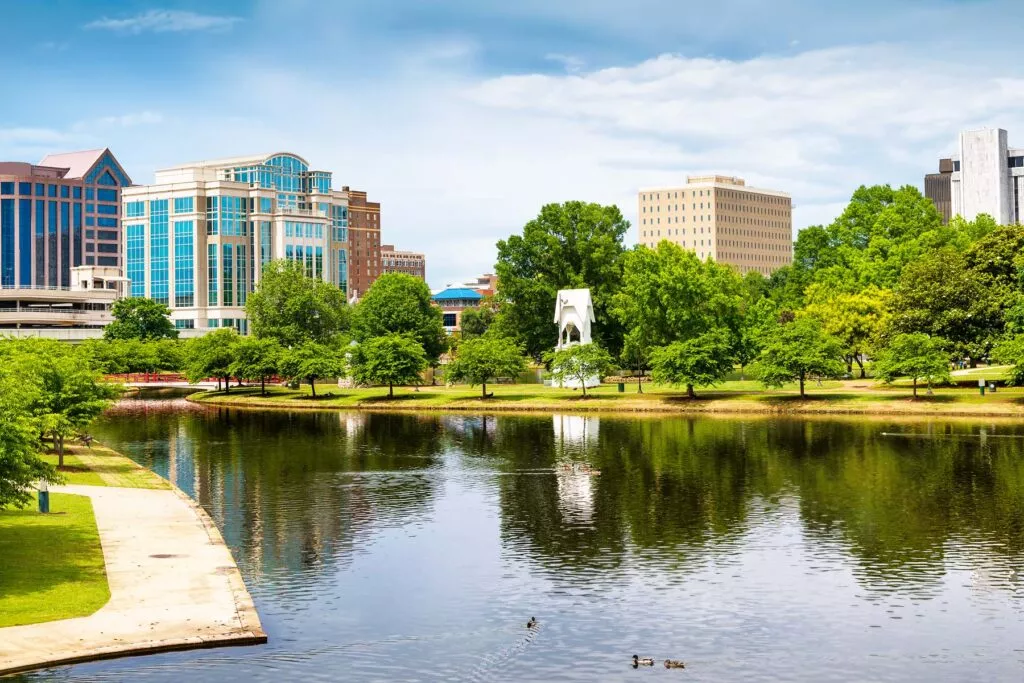
This is not the flat, cotton-field Alabama of the imagination. Huntsville sits up against the southern tail of the Appalachians, so you get real hills, Monte Sano rising right over downtown, and a network of green space and trails that Livability specifically praised. Monte Sano State Park is fifteen minutes from the office towers and feels like an hour away. For a city built on defense contracts and rocket science, it is unexpectedly leafy.
The wider North Alabama region backs that up. The Tennessee River runs through the metro, so lake and river recreation is right there, and you are within a reasonable drive of the Land Trust of North Alabama’s preserves and a stack of state parks. Fall is genuinely lovely, spring is a riot of green, and if you like being outside for the two-thirds of the year that is not oppressively hot or actively stormy, the setting delivers. Nature access is one of the underrated reasons families with kids keep choosing Huntsville over a bigger, flatter, more expensive metro.
- $1,330−0.2%Zillow Observed Rent Index (city) · 2026-0814th cheapest of 106 cities
- $365k±0FRED / realtor.com · 2026-0932nd cheapest of 103 cities
- $290k+0.2%Zillow Home Value Index (city) · 2026-0841st cheapest of 105 cities
- 3.0%−0.1 ptBLS Local Area Unemployment Statistics · 2026-08tied for 7th lowest of 106 cities
- AQI 54ModerateAirNow · 10/07/26tied for 66th cleanest of 105 cities
- $3.96−2.4%AAA · 2026-10-0824th cheapest of 101 cities
Locals’ verdictGrade Huntsville, AL on cost, weather, jobs, people and safety · where it stands on our rankings
The Cons of Living in Huntsville, AL
Now the part the rankings bury in a footnote. None of these are dealbreakers on their own. Stacked together, they are the reason U.S. News and Livability could not agree.
6. The weather can genuinely scare you
Let me be blunt about this, because it is the thing locals downplay to newcomers and then regret. Huntsville sits in Dixie Alley, and Dixie Alley is arguably more dangerous than the classic Tornado Alley out on the Plains. The tornadoes here have a nasty habit of arriving at night, wrapped in rain so you cannot see them coming, over forested terrain. Peak season runs March through May with a second, smaller season stretching into November. The region logs something like 54 inches of rain a year and no shortage of severe storms to go with it.
If you move here, you buy a weather radio, you learn which room is your safe room, and you take the warnings seriously. That is not fear-mongering. It is the local tax you pay for everything else on the pro list. April, in particular, gets a reputation locally as the month everybody watches the sky, and long-time residents can tell you exactly where they were during the worst outbreaks. You do not have to live in fear of it. You do have to respect it, and if that kind of risk keeps you up at night, be honest with yourself before you sign anything.
And the summers are their own event, with heat index readings that hit 109 to 113 during the worst stretches this July. The humidity is a full-body experience from June through September, the kind where you step outside at eight in the morning and your shirt is done for the day. Your power bill in July and August will not be small. None of this is unique to Huntsville, it is the Deep South, but if you are moving from a dry or northern climate, the combination of heat, humidity, and storm anxiety is a bigger adjustment than the brochures let on.
7. You will drive everywhere, and sometimes you will sit
Huntsville grew fast and the roads did not keep up. The daily crunch on I-565 and Research Park Boulevard is real, and heading in from the far-flung bedroom communities, places like Meridianville, Hazel Green, and Toney, can turn a commute into a slog at peak times. It is not Atlanta. But it is worse than a city this size should be, and it is getting worse each year the population climbs.
Public transit is not a serious answer here. The Orbit bus system runs nine routes, Monday through Friday until 9 p.m. and shorter hours on Saturday, and that is the whole story. There is no rail, no real network, nothing that lets you live car-free. If you are coming from a place where you actually used transit, adjust your expectations to zero and budget for a car per adult. I say this plainly because the resident-life tradeoffs matter as much as the job market, the same way they do in a place like Tennessee just across the state line.
8. The tax picture is not as rosy as the property tax
Here is that asterisk I promised. Yes, property taxes are gloriously low. But Alabama makes up for it elsewhere, and you feel it at the checkout counter. The combined sales tax in Huntsville generally runs around 9 percent, and in some special districts it climbs past 10. The state finally cut its grocery tax to 2 percent, which helps, but you are still paying sales tax on food, which a lot of transplants find genuinely startling. On top of that, Alabama levies a state income tax that tops out at 5 percent. So the low property tax is real, but it is one line in a ledger that is more balanced than the billboards suggest.
9. Growth is straining the seams
Adding a couple percent to your population every single year sounds great until you are the one trying to get a doctor’s appointment, enroll a kid mid-year, or buy a house before three other offers land. Huntsville’s city population is now north of 237,000 and climbing around 1.5 percent a year, with the metro past 420,000, and it has ranked among the fastest-growing cities of its size in the country. The very thing that makes it win rankings, the influx of high-earning newcomers, is also crowding the schools, the roads, and the housing supply.
Prices that were a genuine steal five years ago are climbing, and the days of walking into an easy deal are mostly gone in the desirable areas. The city talks a lot about smart growth, and to its credit it plans better than most Sun Belt boomtowns, widening roads and annexing land ahead of demand. But you are still moving into a place that is actively figuring out how to absorb everyone who read the same ranking you did. If you value the version of Huntsville that people describe from ten years ago, small, cheap, uncrowded, know that you are buying the current version, not that one.
10. It can feel a little sterile, and it is still Alabama
This one is subjective, so take it as one honest opinion. Huntsville is a place built around workplaces. A lot of the newer development is subdivisions and shopping centers and office parks, clean and functional and slightly soulless, without the deep, lived-in character of an older Southern city. Downtown has come a long way and is genuinely fun now, but the metro as a whole can read as engineered rather than grown.
And whatever the local bubble tells you, you are still living in Alabama. State-level politics, certain state laws, and the reality of what services the state chooses to fund or not fund will shape your daily life, no matter how many rockets and PhDs surround you. For some people that is a non-issue. For others it is the whole ballgame. I am not going to tell you how to weigh it. I am just not going to pretend the Huntsville tech bubble makes the state disappear.
Tell the next person the thing the guide misses.
So Should You Move to Huntsville?
Here is where I land after weighing all of it. If you work in engineering, aerospace, defense, IT, or anything clearance-adjacent, Huntsville is one of the best deals in the country right now. Deep job market, real salaries, a house you can actually afford, good schools, and more to do than the map suggests. The rankings are not wrong, exactly. They are just selling you the top half of the page.
The bottom half is the night tornadoes, the car-dependent sprawl, the sales tax on your groceries, the growing pains, and the fact that a rocket-science bubble is still floating inside a state whose politics you may or may not share. Those are not reasons to stay away. They are the things a Realtor will wave off and you will live with every day.
Who should skip Huntsville? If you need real public transit and refuse to organize your life around a car, look elsewhere, because that is not changing here anytime soon. If severe-weather anxiety would genuinely erode your quality of life, this is Dixie Alley and no amount of pretty scenery changes that. If your career has nothing to do with defense, aerospace, tech, or healthcare and you were counting on the job market to carry you, the picture is thinner than the Arsenal headlines make it look. And if state-level politics are a hard line for you, no local bubble is going to insulate you from them. Be honest about which of those you are, and the decision usually makes itself.
Weigh both halves. That is the honest local’s only real advice. If you want to compare Huntsville against its regional neighbors before you commit, the write-ups on Georgia and the reasons to think twice about Mississippi are worth a look. Then decide with your eyes open.
For the right person, yes. Livability named Huntsville the number one place to live in the U.S. for 2026 with a score of 873 out of 1,000, largely on the strength of its job market, low cost of living, strong schools, and green space. It is an especially strong fit if you work in aerospace, defense, engineering, or IT. The honest tradeoffs are serious tornado risk, near-total car dependence, sales tax on groceries, and the growing pains of a fast-expanding metro.
Yes, relatively. Huntsville’s cost of living index runs around 97, a few percent below the national average, and the median home sale price was near 322,000 dollars in late 2026 against a median household income around 74,714 dollars. Property taxes are unusually low, with a median effective rate near 0.56 percent in Madison County. The catch is a combined sales tax around 9 percent that also applies to groceries at a reduced state rate, so your overall tax burden is more balanced than the low property tax alone suggests.
The severe weather. Huntsville sits in Dixie Alley, where tornadoes are more deadly than in the classic Great Plains Tornado Alley because they often strike at night, come wrapped in rain, and cross forested terrain. Peak tornado season runs March through May with a secondary season into November, and the area sees roughly 54 inches of rain a year plus brutal summer humidity with heat index values reaching into the 110s. Residents keep a weather radio and a designated safe room and take warnings seriously.
Huntsville, nicknamed the Rocket City, is built on aerospace, defense, and technology. Redstone Arsenal employs around 45,500 people and anchors NASA’s Marshall Space Flight Center, the U.S. Army, the Missile Defense Agency, and an FBI presence. Cummings Research Park, the second-largest research park in the nation, holds roughly 300 companies and more than 26,000 workers in engineering, biotech, software, and defense. Demand is highest for engineers, IT professionals, and anyone able to hold a security clearance.
- What did the guide get wrong about Huntsville, AL?
- What does it actually cost you to live here this year?
- What would you tell someone arriving from out of state?