Knoxville in 2026: The Quick Lay of the Land
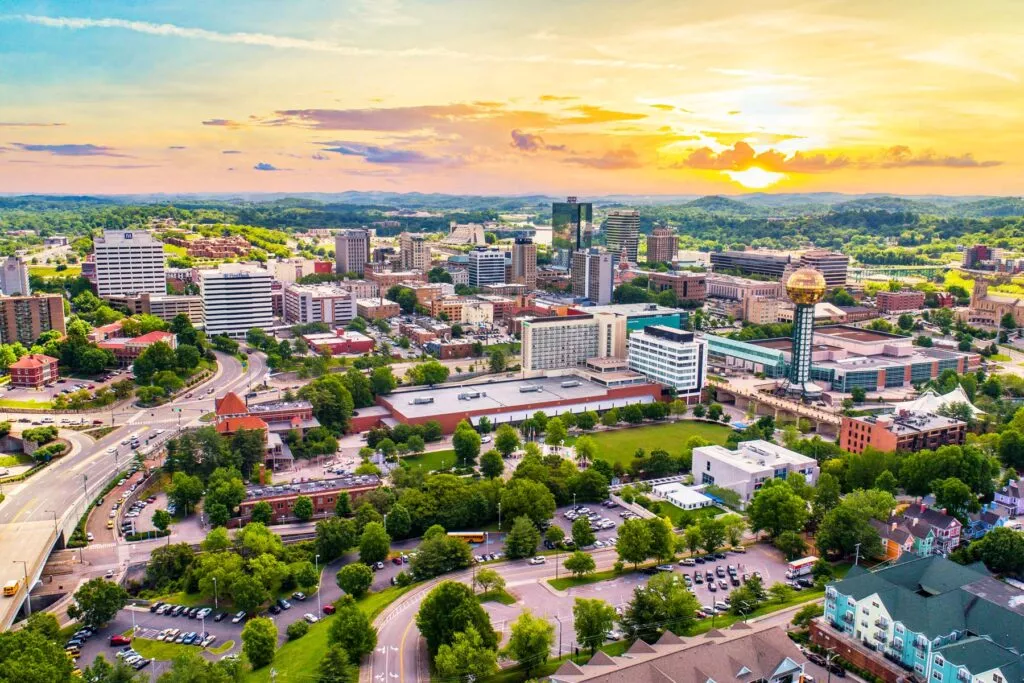
Knoxville is a mid-sized Tennessee city of roughly 204,000 people, with a metro area pushing 807,000 and growing about one percent a year. It sits in the eastern part of the state, in the Tennessee River valley, wrapped by ridges and lakes, with the Smokies to the southeast. It is anchored by the University of Tennessee, the flagship campus with its orange-and-white everything, and by a cluster of serious employers that most people outside the region never think about.
The short version. Knoxville is affordable by national standards, tax-friendly in a way that adds up, outdoorsy in a way few cities can match, and genuinely fun on a fall Saturday. It is also getting expensive fast, thin on transit, hot and sticky in July, and carrying the usual mid-South tradeoffs on wages and city services. Whether it works for you depends almost entirely on one thing: did you buy in early, or are you buying in now? Here is the full breakdown.
The Pros of Living in Knoxville
1. The Smokies Are Basically in Your Backyard
Start with the reason half the newcomers move here. Great Smoky Mountains National Park is the most-visited national park in the United States, and Knoxville is its closest real city. From the south and west sides of town you can be in the foothills in about half an hour, at the Townsend quiet-side entrance in around forty-five minutes, and standing on a ridgeline trail before lunch.
This is not a once-a-year vacation thing for locals. People here hike on a Tuesday evening. They keep kayaks in the garage because the Tennessee River, Fort Loudoun Lake, and Melton Hill Lake are all right there. Fall color season turns the whole region into something absurd. If your idea of a good life includes being outside constantly, Knoxville delivers it at a level that cities twice its size simply cannot.
2. There Is No State Income Tax
Tennessee does not tax wages or salary income. Full stop. Whatever your paycheck says gross, the state takes none of it off the top. For a household earning a solid income, that is real money staying in your account every two weeks compared to what you would lose in a state like California, New York, or even next-door Georgia.
This is the single biggest financial reason people relocate here from higher-tax states, and the migration data backs it up. The top origin states for people moving to the Knoxville metro include California, Illinois, Florida, and New York. Some are chasing the mountains. A lot of them are chasing the take-home pay.
3. Property Taxes Are Refreshingly Low
Knox County has some of the lower effective property tax rates in the country, comfortably under the national median of roughly one percent of home value. On a typical Knoxville home you are looking at a property tax bill that would make a New Jersey or Illinois homeowner weep with envy. Combined with the no-income-tax situation, the overall tax picture for a homeowner here is legitimately attractive.
This is a big part of why retirees keep showing up. No tax on Social Security or pension income, no state income tax on any withdrawals, and a modest annual property bill. If you are on a fixed income, Knoxville’s tax structure does a lot of quiet work in your favor.
4. The Overall Cost of Living Is Still Below Average
Even with the housing jump, Knoxville’s overall cost of living index sits around 86, roughly 14 percent below the national average. Utilities run cheaper than most of the country, healthcare is meaningfully less expensive, and everyday costs like groceries and services stay reasonable. A single adult living modestly can get by on well under what the same lifestyle costs in a coastal metro.
The important nuance is that housing is now the one category dragging that average up, while everything else keeps it low. So your monthly picture depends heavily on renting versus owning, when you bought, and how far out you are willing to live. Get the housing piece right and Knoxville is comfortably affordable. Get it wrong and you lose most of the advantage.
5. SEC Saturdays Are a Genuine Culture, Not a Hobby
You cannot write honestly about Knoxville without talking about football, because for a good chunk of the year it organizes the entire city. Neyland Stadium seats 101,915 people, making it one of the largest stadiums in the country, and when Tennessee plays at home the whole town turns orange. The Vol Navy, the flotilla that docks along the river and tailgates on the water, is genuinely unique. Checker Neyland, the running-through-the-T, the noise. It is a lot.
Even if you did not grow up caring about college football, living here tends to convert you. Restaurants and bars fill up, downtown buzzes, and there is a communal energy on a fall Saturday that is hard to find in cities without a program like this. If you love that, Knoxville hands it to you on a plate. If you are indifferent to sports, just know that seven or eight weekends a year the town is not really yours.
6. The Job Market Is Steadier Than People Expect
Knoxville is not just a college town living off tuition. It has a surprisingly resilient employment base built on a handful of large, stable institutions. The University of Tennessee employs somewhere north of 11,000 people. Covenant Health, the regional hospital system, also employs more than 11,000. Just up the road, Oak Ridge National Laboratory, the largest science and energy lab in the Department of Energy system, staffs several thousand researchers and support workers. And the Tennessee Valley Authority keeps its headquarters right downtown.
Education, healthcare, energy research, and government. Those are not boom-and-bust industries. That mix is a big reason the local economy held up through the last few downturns and why the metro keeps growing. If you work in any of those fields, or in the businesses that orbit them, Knoxville offers a level of stability that a lot of trendier cities cannot.
7. Downtown Actually Came Back to Life
Twenty years ago, downtown Knoxville was mostly empty after five o’clock. That has changed dramatically. Market Square, the pedestrian plaza at the heart of downtown, was rebuilt starting in the early 2000s and is now the city’s living room. Restaurants, patios, a farmers market, live music, festivals. Gay Street and the surrounding blocks fill in around it with theaters, breweries, and shops, and the Old City district gives you the nightlife.
It is not a huge downtown, and it will not be confused with a major metro. But it is walkable, it has real character, and it is genuinely pleasant to spend an evening there. For a city Knoxville’s size, that kind of functioning, populated core is not something you can take for granted, and it is one of the most underrated things about living here.
8. The Airport Is Small, Close, and Getting Better
McGhee Tyson Airport (TYS) sits about 12 miles south of downtown, which means you can go from your driveway to your gate in under half an hour, a genuine luxury after living near a big-city airport. It offers nonstop service to more than 30 destinations across six airlines, and it just got better in March 2026 when Southwest launched service with nonstop flights to Nashville, Baltimore, Dallas, and Orlando.
You will still connect through a hub for a lot of international or less-common routes, so it is not a substitute for a major airport. But for a metro this size, the combination of close, easy, and improving is a real quality-of-life perk that people who fly regularly learn to appreciate fast.
- $1,701+0.1%Zillow Observed Rent Index (city) · 2026-0961st cheapest of 106 cities
- $447k−0.6%FRED / realtor.com · 2026-0965th cheapest of 103 cities
- $369k±0Zillow Home Value Index (city) · 2026-0960th cheapest of 105 cities
- 3.2%±0 ptBLS Local Area Unemployment Statistics · 2026-0813th lowest of 106 cities
- AQI 44GoodAirNow · 10/20/26tied for 49th cleanest of 105 cities
- $3.80−2.3%AAA · 2026-10-2118th cheapest of 101 cities
Locals’ verdictGrade Knoxville on cost, weather, jobs, people and safety · where it stands on our rankings
The Cons of Living in Knoxville
9. The Sales Tax Bites Every Purchase
Here is the catch nobody mentions when they brag about no income tax. Tennessee makes up for it at the register. The combined sales tax rate in Knoxville is 9.25 percent, one of the highest in the country, and unlike some states, Tennessee taxes groceries too, just at a slightly reduced rate. Every gallon of milk, every pair of shoes, every restaurant tab carries that load.
For high earners, the trade is a clear win. You spend a smaller share of your income, so the no-income-tax deal beats the sales-tax hit easily. For lower-income households that spend most of what they make, the math is far less friendly. This is a genuinely regressive tax structure, and it is worth understanding which side of it you land on before you fall in love with the words “no income tax.”
10. The Housing Boom Has Been Brutal on Buyers
Now the hard part. Knoxville has had, by several measures, among the fastest-rising home prices in the entire country over the past five to six years. Median home values in the metro climbed somewhere in the neighborhood of 83 to 86 percent between 2019 and 2025. Prices that started around $190,000 before the pandemic now sit in the $350,000 to $400,000 range depending on which survey you read and where in the metro you look.
That is a staggering run, and it is the direct result of remote workers from expensive coastal states discovering they could buy a house near the Smokies for half of what they paid back home. Great for them. Rough for the local teacher, nurse, or line cook who watched their hometown reprice around them in real time.
The good news, if you are looking now, is that the frenzy has cooled. Homes are sitting on the market longer than they did in 2024, inventory is climbing back toward a balanced market, and price growth has slowed to a modest single-digit pace. Knoxville is still affordable compared to Denver or Nashville. It is just no longer the bargain it was, and anyone selling you the pre-2020 pricing narrative is selling you a house that no longer exists.
11. Game-Day Logistics Can Be a Nightmare
The flip side of a hundred thousand people descending on your city is exactly what you would expect. Traffic on home-game Saturdays is bad, parking near campus and downtown becomes a competitive sport, and if you live on the west or south side you learn to plan your errands around the schedule. Rideshare pricing surges, restaurant waits balloon, and the interstate through town backs up.
Locals adapt. They shop on Friday, avoid the Cumberland Avenue strip on game day, and either lean into the tailgate or leave town entirely. But it is a real, recurring inconvenience, and if you happen to live in the wrong pocket of the city, the football calendar quietly becomes your calendar too.
12. The Wages Run Lower to Match
Stability comes with a ceiling. Knoxville salaries are noticeably lower than the national average, and the median household income here sits well below the national figure. The low cost of living is supposed to offset that, and for many households it does. But if you are moving from a high-wage market and cannot keep your remote salary, you will feel the drop.
The people winning hardest in Knoxville right now are the ones who brought a coastal paycheck with them and pay local prices. If you are job-hunting locally instead, temper your expectations. The tradeoff can still absolutely work in your favor, but do the arithmetic on your specific offer before you commit, not the arithmetic on the brochure.
13. You Will Need a Car for Everything Else
Outside of that downtown core and the immediate campus area, Knoxville is a car city, full stop. Public transit exists but it is limited, infrequent, and not designed for a car-free life. The metro is spread out across ridges and valleys, so neighborhoods, shopping, and schools are stitched together by interstate and arterial roads rather than by anything you would want to walk or bike.
If you are coming from a walkable city and hoping to ditch your car, adjust that plan now. Nearly every household here needs at least one vehicle, and most need two. Budget for the gas, the insurance, and the parking, because in the day-to-day math of living here, the car is not optional.
14. The Summers Are Hot, Humid, and Long
Knoxville has a humid subtropical climate, which is a polite way of saying the summers are sticky. July highs run in the upper 80s and frequently push into the 90s, and the humidity sits in the 70 percent range for weeks at a time. The city gets around 55 inches of rain a year, spread fairly evenly, so muggy afternoon thunderstorms are just part of the deal from June through September.
The upside is real. Winters here are mild by most standards, with only about four inches of snow a year and short cold spells rather than long deep freezes. Spring and fall are genuinely gorgeous. But if you wilt in heat and humidity, know that Knoxville’s warm season is long and it does not let up much at night.
15. Crime and Services Vary a Lot by Neighborhood
Citywide, Knoxville’s crime numbers run above the national average, which surprises some newcomers who picture a quiet mountain town. As in most cities, that figure is heavily concentrated in specific areas, and the trend has been improving, with reported crime falling year over year recently. The safer, family-oriented pockets are mostly on the west and south sides, in areas like West Knoxville, Farragut, and Hardin Valley, where master-planned neighborhoods and well-regarded schools cluster.
The practical takeaway is that Knoxville rewards doing your homework. Do not judge the whole city by one statistic. Pick your specific neighborhood carefully, look at the school zoning, and spend time in an area at different hours before you commit. The difference in feel from one part of the metro to another is larger than the citywide averages suggest.
Tell the next person the thing the guide misses.
Who Knoxville Actually Fits
Picture two people standing in the same Market Square on the same afternoon. The first is a remote software engineer who kept a Bay Area salary, closed on a house in Farragut, and now hikes in the Smokies on weeknights while paying no state income tax and a property bill a fraction of what she used to. Knoxville is close to a cheat code for her. The second grew up here, drives a delivery route, and is watching the only city he knows get priced past his reach while the sales tax nicks every grocery run. Same city, opposite experience. Which one you resemble tells you most of what you need to know.
Knoxville fits you if the outdoors sit near the top of your list, if you are bringing a strong salary or landing in one of the anchor employers that keep this economy steady, and if a car-dependent, football-shaped, subtropical rhythm sounds like a life rather than a compromise. It fits you less well if you need real transit, if you are buying at 2026 prices on a local wage, or if long humid summers wear you down. The version of Knoxville that made national relocation lists is exactly the version that got more expensive, so price it as it is today, walk the specific neighborhood at a few different hours, and run the numbers against your own household rather than the one in the ad. Do that, and most people who land here are glad they made the drive.
For more on the region, it is worth reading the wider honest pros and cons of living in Tennessee as a whole, since the statewide tax and cost picture shapes a lot of what happens locally. If you are weighing Knoxville against other Tennessee cities, compare it with the realities of living in Nashville and the tradeoffs of living in Memphis, which pull in very different directions on cost and culture. And if you are still narrowing down a metro, the roundup of the best places to live in Tennessee and the most livable cities across the South is a useful next step.
Frequently Asked Questions About Living in Knoxville
Mostly, yes. Knoxville’s overall cost of living index sits around 86, roughly 14 percent below the national average, with cheaper utilities and healthcare than most of the country. The one exception is housing. After several years as one of the fastest-rising markets in the nation, the metro median home price now sits in the 350,000 to 400,000 dollar range, so affordability depends heavily on when you buy and how far out you live.
Tennessee has no state income tax on wages, which is the biggest draw for people relocating from higher-tax states. The tradeoff is a high combined sales tax of 9.25 percent in Knoxville, which even applies to groceries at a reduced rate. Property taxes are low, though, with Knox County’s effective rate sitting comfortably below the national median of about one percent of home value.
Very close, which is a major reason people move here. Great Smoky Mountains National Park is the most-visited national park in the country, and from the south and west sides of Knoxville you can reach the foothills in about thirty minutes. The Townsend quiet-side entrance is roughly forty-five minutes from downtown and the Gatlinburg entrance about an hour.
Knoxville has a humid subtropical climate with four seasons. Summers are hot and sticky, with July highs in the upper 80s and often into the 90s and humidity in the 70 percent range. The city gets about 55 inches of rain a year and only around 4 inches of snow, so winters are relatively mild, while spring and fall are the standout seasons.
It is steadier than most people expect. Knoxville’s economy leans on large, stable institutions, including the University of Tennessee and Covenant Health, each employing more than 11,000 people, plus Oak Ridge National Laboratory and the Tennessee Valley Authority headquarters. Those education, healthcare, energy, and government sectors hold up well in downturns, though local wages run below the national average, so the low cost of living is meant to offset a smaller paycheck.
- What did the guide get wrong about Knoxville?
- What does it actually cost you to live here this year?
- What would you tell someone arriving from out of state?