The Pros of Living in Chattanooga
1. The internet is genuinely the best in the country
The city’s public utility, EPB, runs a 100 percent fiber network, and in 2010 it became the first provider in the United States to offer citywide gigabit service. That is where the “Gig City” nickname comes from. In 2015 EPB was the first in the world to deliver 10 gigabit to every home and business, and in 2022 it launched community-wide 25 gigabit symmetrical service, again a national first, reaching essentially the whole city.
Here is what that means in real life. Symmetrical is the key word. Your upload speed matches your download speed, which almost no cable company gives you. If you work from home, run video calls all day, back up huge files, or share a house with three other people all streaming and gaming at once, you will never think about your connection again. It is a legitimate, quantifiable reason to pick Chattanooga over a prettier city with worse infrastructure. Not many places can say their broadband is a selling point over their scenery. It also matters that EPB is community-owned rather than a national cable brand, which is why the profits loop back into faster tiers instead of shareholder dividends.
2. Mountains and a river, right there
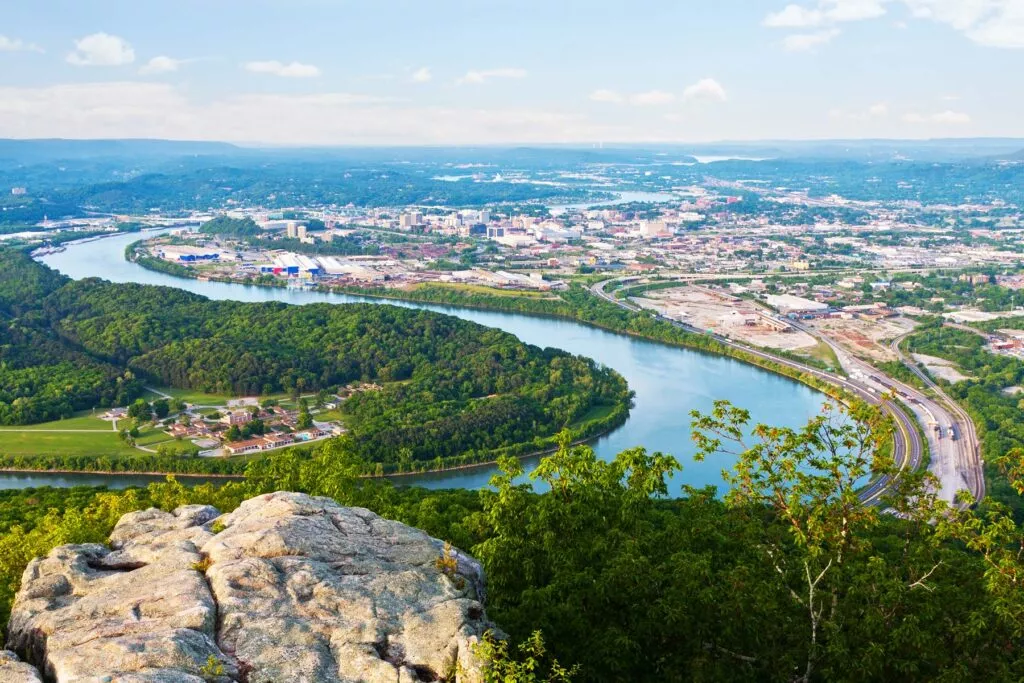
Chattanooga sits in a bowl ringed by ridges, and the outdoor access is absurd for a city this size. Lookout Mountain and Signal Mountain frame the skyline, the Tennessee River cuts through the middle of downtown, and the Tennessee Riverwalk gives you miles of paved trail along the water. In April 2025 the city became North America’s first National Park City, a designation shared globally at that point with only London and Adelaide. It is an honorary title from a foundation, not the National Park Service, but it reflects something true about how much green space and public land is woven into the place.
For climbers it is close to holy ground. Sunset Rock on Lookout Mountain is some of the finest single-pitch trad climbing in the South, Stone Fort (locals call it Little Rock City) has over 700 bouldering problems and hosts a leg of the Triple Crown competition, and the Tennessee Wall along the river gorge is nationally known. If your ideal weekend is a trail, a crag, or a paddle instead of a mall, you will feel like you got away with something. It is a big reason Chattanooga keeps landing on “best places to live” lists. My roundup of the best places to live in Tennessee gets into how it stacks up against the rest of the state on this.
3. No state income tax
Tennessee does not tax wage income. Full stop. For a household pulling a solid salary, especially two earners, that is real money left in the account every month compared to a state like California or New York. Combine it with a cost of living that runs about 12 percent below the national average, and Chattanooga does something rare. It lets middle-income people actually build savings. The catch is that the state makes the money back at the register.
4. It is still affordable, if not the steal it used to be
Housing here is roughly 23 percent cheaper than the U.S. average. The average home value sits around 328,000 dollars, and the median household income is near 61,000 dollars. Average rent runs about 1,464 dollars a month. Those are not 2015 numbers anymore, and locals will tell you flat out that prices jumped when the pandemic sent remote workers south from Los Angeles, Seattle, and New York. But against Nashville, three hours up I-24, or against any coastal metro, Chattanooga is still a bargain. You can buy a real house on a normal salary here.
5. A real economy, not just tourism
Some scenic cities are pretty and jobless. Chattanooga is not. The largest employers are a genuinely diverse bunch. BlueCross BlueShield of Tennessee is headquartered here with over 6,000 employees, Erlanger Health has more than 5,600, the Volkswagen assembly plant employs close to 4,000 and builds EVs, and Unum, the insurance company, has over 3,000. Add Tennessee Valley Authority, CHI Memorial, Hamilton County Schools, the University of Tennessee at Chattanooga, and a growing tech and cybersecurity scene, and you have insurance, advanced manufacturing, healthcare, logistics, and government all in one metro. That diversity is what keeps a city stable when one sector wobbles.
The tech angle deserves its own note, because it ties back to the fiber. That world-class network did not just make streaming nice, it made Chattanooga a real place to build a tech and cybersecurity workforce. Employers here list tech salaries reaching into the six figures, and the University of Tennessee at Chattanooga feeds a steady stream of graduates into the local economy. For a city this size to have both blue-collar manufacturing jobs at Volkswagen and white-collar insurance and tech jobs is genuinely unusual, and it means a two-income household can often find work for both people without one of them commuting to another metro.
6. A downtown and a food scene worth walking to
For all the growing pains, the core of Chattanooga is legitimately fun. The riverfront around the Tennessee Aquarium and the Walnut Street Bridge, one of the longest pedestrian bridges in the world, is a genuine gathering place. There is a craft beer scene punching well above the city’s weight, a walkable stretch of restaurants and coffee shops, and a compact enough core that a night out does not require a highway. The transformation from the polluted industrial city of the 1970s into this is one of the more remarkable urban comebacks in the country, and on a good spring evening downtown it shows. The trick, as always here, is that this polish is concentrated. It is real, it is just not everywhere.
7. A free electric shuttle ties the core together
Here is a small thing that punches above its weight, and it surprises newcomers because it cuts against the car-dependence in the cons below. CARTA runs a free downtown electric shuttle that loops between the Chattanooga Choo Choo on the south end and the Tennessee Aquarium on the riverfront, stopping at just about every block in between. It runs roughly every ten minutes, is wheelchair accessible, and costs nothing to board. Chattanooga was an early adopter of battery-electric transit and has been running these zero-fare shuttles downtown since long before it was fashionable.
What that buys you in practice is a genuinely car-light downtown day. Park once in a Shuttle Park garage, then hop the shuttle to the Southside, the North Shore across the bridge, St. Elmo at the foot of Lookout Mountain, or the aquarium, without moving your car or hunting a second parking spot. If you live or work in the core, it changes the daily math in a way most mid-size cities cannot offer. It does not replace owning a car for the rest of your life here, but for the downtown itself it is a real, functioning amenity rather than a brochure promise.
8. Short commutes give you your evenings back
This is the quiet perk nobody puts on a relocation flyer. The median commute in Chattanooga runs about 19 minutes, well under the Tennessee median of roughly 25 minutes and the national figure of nearly 27. When people move here from a big metro, the number that actually changes their life is not the tax rate, it is the drive. Fifteen to twenty minutes door to door instead of forty-five each way adds up to hours back every week, and those hours are why the outdoor access is livable at all. You can actually get to a trailhead on Lookout Mountain after work instead of only on Saturday.
The honest asterisk is that the growth has started nibbling at this. The main arteries at rush hour are heavier than they were five years ago, and a few corridors near the interstates back up in ways longtime locals grumble about. But even with that creep, the baseline is short. Compared with the crawl in our Nashville pros and cons breakdown, Chattanooga’s commute is still one of its most underrated everyday advantages.
- $1,498−0.1%Zillow Observed Rent Index (city) · 2026-0936th cheapest of 106 cities
- $395k−1.0%FRED / realtor.com · 2026-0946th cheapest of 103 cities
- $315k−0.2%Zillow Home Value Index (city) · 2026-0946th cheapest of 105 cities
- 3.4%+0.1 ptBLS Local Area Unemployment Statistics · 2026-08tied for 18th lowest of 106 cities
- AQI 55ModerateAirNow · 10/26/26tied for 74th cleanest of 105 cities
- $3.69+1.6%AAA · 2026-10-2714th cheapest of 101 cities
Locals’ verdictGrade Chattanooga on cost, weather, jobs, people and safety · where it stands on our rankings
The Cons of Living in Chattanooga
9. Downtown is growing faster than its bones can handle
This is the part nobody puts on a billboard. Chattanooga’s downtown transformation is a genuine American comeback story. This is a city that was literally named the dirtiest in the country in 1969, and it cleaned up its river, built the Tennessee Aquarium, laid the Riverwalk, and turned into a place people want to move to. Real success.
But growth outran the infrastructure. The roads were not built for this many people, and traffic on the main arteries has gotten noticeably worse. Homelessness and petty disorder downtown rose after 2020 and, by 2026, remain elevated above where they were before, even as serious crime has largely settled back to pre-2020 levels. The city is actively working the problem with more supportive housing, new shelter capacity, and bike and foot patrols downtown, and it has pushed the numbers down from the peak. But if you move here picturing a polished, seamless downtown, you will notice the gap between the riverfront glow and the streets a few blocks over. The nice development did not reach the whole city evenly, and lower-income neighborhoods got left behind on things like safe roads and services.
10. Public transit is thin, so you need a car
The free downtown shuttle is great, but do not let it fool you about the wider picture. CARTA, the regional transit authority, exists, but its bus network is not something you can realistically live on the way you would in a big transit city. Service is limited, coverage is patchy, and the moment you step outside the core you will be driving for everything. Even the beloved Lookout Mountain Incline Railway, which CARTA operates and which has run since 1895, was knocked out by a wildfire on the mountain in December 2024 and spent much of the following stretch closed for repairs. Point being, do not move here expecting to skip car ownership. You cannot. Budget for a vehicle, insurance, and gas, and factor that into the affordability math. This is one place Chattanooga trails a more built-up city, though the trade-off is that the driving you do here is short.
11. The summers are humid
Chattanooga has a humid subtropical climate, which is a polite way of saying June through September can be a slog. Highs push into the upper 80s with relative humidity around 75 percent, and that combination makes the air feel heavy and close, the kind of afternoon where you are damp walking to the car. Winters are mild and short, which is a genuine plus, and spring and fall are gorgeous. But if you are coming from a dry Western climate, the summer stickiness is a real adjustment. People underestimate it because they visit in October. A July walk along the Riverwalk at three in the afternoon tells you far more than a glossy fall photo ever will.
12. You pay for that no-income-tax perk at the register
Tennessee balances its no-income-tax books with sales tax, and it is high. The combined rate in Chattanooga is 9.25 percent, 7 percent state plus 2.25 percent county. Groceries, goods, the works. For a high earner the trade is fantastic, since you dodge income tax and only pay more when you spend. For a lower-income household that spends most of what it makes, the sales tax bites harder and the income-tax break matters less. It is worth running your own numbers rather than assuming “no income tax” automatically means cheaper for you. Sometimes it does, sometimes it is close to a wash.
13. Growth means competition and change
The same in-migration that keeps the economy humming also means more people bidding on the same houses, more crowded trails on a nice Saturday, and a downtown that does not feel like the sleepy secret it was a decade ago. Longtime locals have mixed feelings, and newcomers sometimes arrive expecting a quiet mountain town and find a small city with big-city growing pains. It is not ruined. It is just busier and pricier than the version people fell in love with, and that trajectory is still pointing up.
14. It is a smaller city, with the limits that implies
This one is not a knock so much as a reality check. Chattanooga is a mid-size city, not a metropolis. The airport, CHA, is small, so a lot of trips mean connecting through a hub or driving two hours to Atlanta for a direct flight. Big touring acts, major-league sports, and the full big-city cultural buffet are things you drive to Atlanta or Nashville for. The local sports scene tops out at the Chattanooga Lookouts, the Double-A baseball team, which is a genuinely fun summer night but not the same as a pro franchise. The nightlife is real but modest. If you are coming from a city where you never had to leave for anything, Chattanooga will feel intimate in a good way most of the time and a little limiting on the weekend you want something bigger. Plenty of people consider that a fair trade for mountains and affordability. Just know it going in.
15. The heat is not the only weather to plan for
One more honest note on climate. Chattanooga sits in a valley in the Southeast, which means it gets its share of severe spring weather, thunderstorms, and the occasional tornado watch that comes with living in this part of the country. The flip side is that hard winters are rare and snow is a novelty, so you trade shoveling and ice for humidity and storm season. For most people moving from the North that is a welcome swap. For someone coming from a dry, stable Western climate, the combination of summer humidity and active spring weather is the biggest adjustment, bigger than the cost of living or the traffic. It is worth a real think, not a shrug.
Tell the next person the thing the guide misses.
So Who Actually Thrives in Chattanooga?
Chattanooga is close to perfect for remote workers and outdoor people. If your income comes over that world-class fiber and your free time goes to climbing, paddling, hiking, or biking, you will get a quality of life here that costs three times as much in Colorado or the Pacific Northwest. Young families do well too, drawn by the affordability, the no-income-tax math, and the real job market. It also fits anyone leaving an expensive metro who wants mountains and a river without the coastal price tag. If that is you, it belongs on your short list right next to the other cities in our best places to live in the South guide.
Who should think twice? Anyone who needs walkable, car-free, big-city density. Anyone who wilts in humidity and cannot picture four sticky months a year. And anyone expecting a finished, polished downtown, because Chattanooga is still very much a work in progress on transit, roads, and services. If a genuinely urban feel matters more to you than mountain access, a bigger city like Memphis might scratch a different itch, and our Memphis pros and cons piece lays out that trade.
The whole city comes down to one uncommon pairing: elite internet and elite outdoor access, at a price a normal salary can carry, in a state that leaves your paycheck alone. You buy that with humidity, a car in the driveway, and a downtown that is still under construction in every sense. What tips people one way or the other is rarely the spreadsheet. It is whether the picture of a fifteen-minute drive to a Lookout Mountain trailhead after work reads as freedom or as too small a life. If it reads as freedom, Chattanooga will likely feel like home faster than you expect. Rent for a season before you commit if you can swing it, spend one of those seasons in the thick of a Tennessee summer, and let the place answer the question for you.
Chattanooga Pros and Cons FAQ
For a lot of people, yes. The draw is real. Chattanooga has one of the fastest, most reliable internet networks in the country through EPB, a cost of living roughly 12 percent below the national average, no state income tax, and mountains and river access most cities would kill for. The honest catch is that downtown is growing faster than its roads, transit, and services can keep up, and summers are genuinely humid. It rewards people who want outdoor access and remote-work infrastructure over a walkable big-city lifestyle.
The overall cost of living runs about 12 percent below the national average, with housing around 23 percent cheaper than the U.S. average. The average Chattanooga home value sits near 328,000 dollars and the median household income is about 61,000 dollars. Average rent is roughly 1,464 dollars a month. It is not the bargain it was five years ago, since prices climbed with the wave of newcomers, but it still beats coastal metros badly.
No. Tennessee has no state income tax on wages, which is one of Chattanooga’s biggest financial draws. The trade-off is a high sales tax. The combined rate in Chattanooga is 9.25 percent, made up of 7 percent state and 2.25 percent Hamilton County. So you keep more of your paycheck but pay more at the register, and it hits lower spenders hardest.
Chattanooga earned the nickname because its municipal utility, EPB, was the first in the country to offer citywide gigabit fiber back in 2010, then the first in the world to hit 10 gigabit in 2015. In 2022 it launched community-wide 25 gigabit symmetrical service, the first anywhere. For remote workers and anyone who lives online, the internet here is not a compromise, it is a selling point.
The main ones are downtown growing pains, thin public transit, humid summers, and uneven growth. The riverfront and city core have been transformed, but the roads, transit, and homeless services have not kept pace, and disorder downtown remains above pre-2020 levels even as the city works on it. Public transit through CARTA is limited outside the free downtown shuttle, so you will need a car. And June through September the humidity is heavy.
- What did the guide get wrong about Chattanooga?
- What does it actually cost you to live here this year?
- What would you tell someone arriving from out of state?