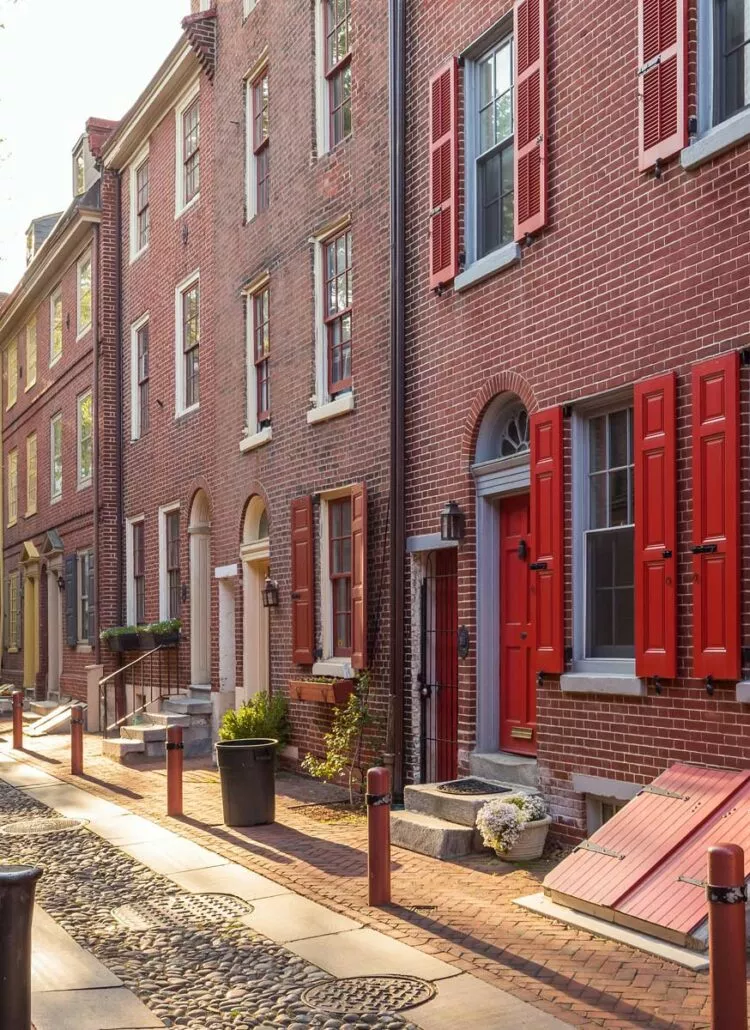

First, the Pros of Living in Chicago
#1. The People
First and foremost, allow me to start with my favorite thing about living in Chicago — the people. I don’t know what it is, but I swear the people that live in Chicago are some of the kindest I’ve met. I feel that Chicagoans are genuinely friendly and down-to-earth in a way that is not common in large cities.
When I first moved to Chicago, I was constantly lost (surprise, surprise) and can’t recall a single situation where I wasn’t approached by someone helpful and willing to offer assistance. I’ve lost count of the number of helpful interactions I’ve experienced personally while living in Chicago!
Heads up! If you’re a millennial, you’ll find a lot of like-minded folks to befriend while living in Chicago because Chicago is considered one of the best cities in the country for millennials to live.
#2. The Cost of Living
Like most major cities, the cost of living in Chicago is higher than the national average. But when compared to other large cities, it’s easily the most affordable option. I mean, Chicago seldom makes an appearance on lists ranking the most expensive cities in the country for a reason! You can actually enjoy living here because it’s not cost-prohibitive.
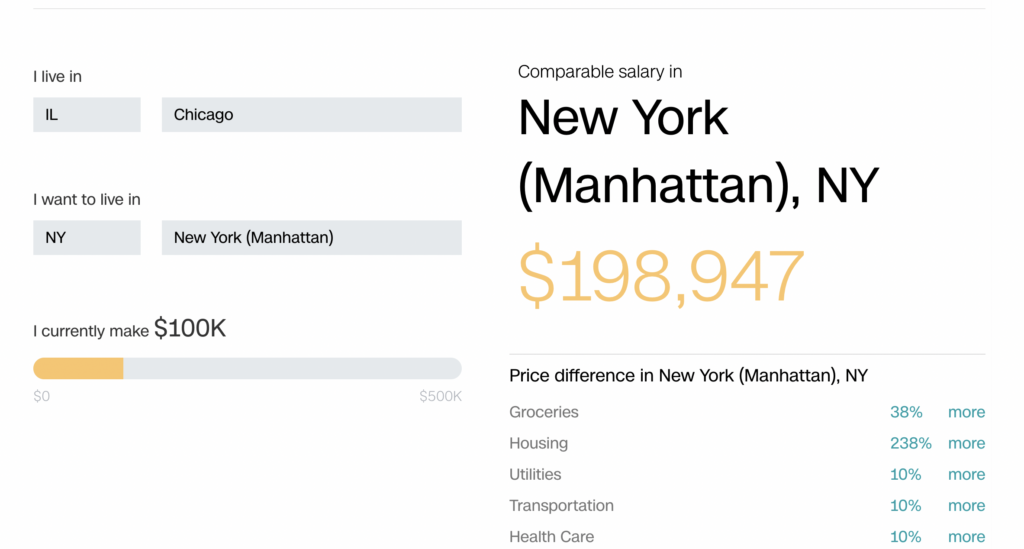
For example, there’s a lot of comparison between Chicago and NYC (both skyscraper cities), but the difference in cost of living couldn’t be more different. According to CNN’s cost of living calculator, a $100,000 salary in Chicago is equal to $199,000 in New York City (that’s double!).
Housing alone is 238% more expensive in NYC than Chicago yet you’ll have access to all of the same amenities while living in Chicago. I played around with the calculator for a while and the theme is the same, Chicago is much more affordable than other large US cities.
I’m guessing the harsh winters (we’ll cover those shortly) have something to do with the reasonable cost of living in Chicago. Regardless of the reason, you won’t find me complaining, that’s for sure.
#3. Cultural Activities
One of my favorite things about living in Chicago is having access to a plethora of cultural activities every day of the week. In fact, Chicago ranks as one of the best cultural cities in America. You’ll have access to world-class museums like the Field Museum of Natural History (which rivals the one in NYC) and the Art Institute of Chicago.
If you’re in the mood to catch a great performance you can have your pick from three epic theaters: Chicago Theater, Goodman Theater and Steppenwolf Theater (which is currently undergoing a $54M expansion). Oh, and lest I forget, Chicago is known for having one of the best music scenes in the country.
Lollapalooza is a must for music fans, the Chicago Blues Festival is a clear crowd favorite, and the plethora of jazz festivals are bound to keep you entertained every season of the year, especially summer.

#4. The Food Scene
If you plan on moving to Chicago, one thing is certain — you’ll never go hungry. When most folks think of foodie cities, I don’t think Chicago comes to mind, which is a pity considering the city currently ranks as the third best foodie city in the country. You read that right.
I can tell you from firsthand experience that it lives up the hype. You’ll have access to SO many interesting restaurants and cuisines while living in Chicago, I barely know where to start. The diverse food scene is impressive, especially in terms of ethnic restaurants. Oh, and I would be remiss to overlook the famous Chicago deep-dish pizzas and loaded hotdogs perfected in this city. Anyway you slice it, you will be exposed to an awesome food scene while living in Chicago.
#5. Chicago Is A Diverse City
Chicago is considered one of the most racially diverse large cities in America. Approximately 52% of the population identifies as white, and 29% identifies as black. I love living in a diverse city because I’m exposed to customs and cultures I didn’t grow up around. I’ve found it fairly easy to befriend both native Chicagoans and recent transplants. My friends circle has grown from being fairly homogeneous to more diverse and interesting — a huge perk of living in Chicago, if you ask me.

#6. The Airports Are Top-Notch
As an avid traveler, having access to a good airport was a major factor in my decision to move to Chicago. And it seems like I’m not alone in this regard. Considering the amount of business being conducted in the city, a ton of folks fly into and out of Chicago on a daily basis so having an effective airport is non-negotiable.
There’s a handful of airports that serve Chicago, but the biggest one takes the cake — O’Hare International Airport. Offering more than 220 nonstop flights, the O’Hare International Airport is the third busiest in the country — serving 83 million passengers in 2018 alone! The effectiveness of Chicago’s main airport is a huge perk of living in Chicago, especially if you fly often.
#7. Public Transportation
It’s hard to find an American city that feels livable without a car, but Chicago is a rare exception. In fact, Chicago’s public transportation system is considered the 6th best in the country. As you know, most folks loves to hate on public transportation, but nearly 91% of Chicago residents approve of the public transpiration offered, myself included.
Thanks to the CTA (Chicago Transit Authority), you’ll always be able to get where you need to without much fuss or delay. When I first moved to Chicago I brought my car because my job was located downtown but I lived in the suburbs. Within one year of this arrangement, I decided to move downtown and ditch the car altogether because parking became too much of a hassle and I was satisfied with the CTA.
Also worth mention, the metro system is very effective at connecting the suburbs to the downtown core. So if you’re moving to a suburb of Chicago, I suggest testing out the public transportation for a year before deciding whether you want to keep your car. Based on personal experience, living in Chicago without a car is a breeze.
#8. Housing Cost
Considering the size of Chicago, housing is surprisingly affordable by big city standards. As of 2021, the median cost of a home in Chicago clocks in at $340,000. Let me tell you, as someone that hails from New York, this price seems surreal.
But wait, it gets better. Chicago has the 4th highest concentration of Fortune 500 companies in the US (36 companies total). By and large, these jobs pay higher salaries, the average salary in Chicago is $72,000. Between the reasonable home prices and decent annual salary, it’s actually possible to consider owning a home in Chicago — an achievement most city dwellers can’t even afford to dream about.
Looking for the right neighborhood for you? Read: A Guide to the 10 Best Neighborhoods in Chicago
#9. The Sports Culture
Ready to hear the understatement of the century? If you’re a major sports fan, you’re going to LOVE living in Chicago. Home to five sports teams (Chicago Bulls, Chicago White Sox, Chicago Cubs, Chicago Bears, Chicago Blackhawks) and 27 championships, living in Chicago is a great option for those that like to brag about winning sports teams!
#10. The City’s Architecture Is World Class
Yet another unexpected perk of living in Chicago is the constant exposure to world-class architecture. I’ll be the first to admit I know nothing about architecture, but I can still appreciate an aesthetically beautiful building. Thankfully there’s plenty to admire in Chicago.
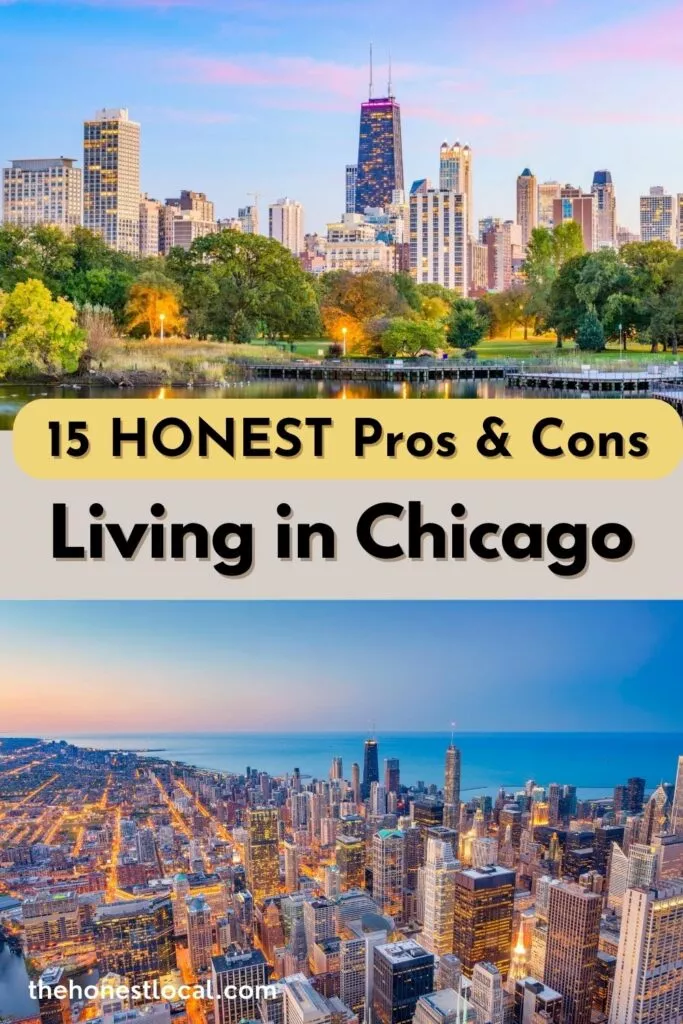
The Great Chicago Fire of 1871 gave birth to a revolutionary idea that officially kicked off the modern high rises we see today — buildings constructed of steel rather than wood, imagine! These buildings make up Chicago’s epic skyline, considered one of the best in the country.
Tip: One of the best ways to enjoy Chicago’s magnificent skyline is by boat, an experience I can’t recommend enough.

Thinking about visiting before finalizing your decision to move to Chicago? If helpful, here’s the best hotel in town (it’s the one I recommend to my own family and friends).
- $2,342−0.1%Zillow Observed Rent Index (city) · 2026-0894th cheapest of 106 cities
- $389k−1.4%FRED / realtor.com · 2026-0943rd cheapest of 103 cities
- $334k+0.8%Zillow Home Value Index (city) · 2026-0853rd cheapest of 105 cities
- 5.2%+0.3 ptBLS Local Area Unemployment Statistics · 2026-08tied for 95th lowest of 106 cities
- AQI 46GoodAirNow · 10/07/26tied for 38th cleanest of 105 cities
- $5.06−0.9%AAA · 2026-10-0885th cheapest of 101 cities
Locals’ verdictGrade Chicago on cost, weather, jobs, people and safety · where it stands on our rankings
Cons of Moving to Chicago
#1. Winters in Chicago Are Brutal
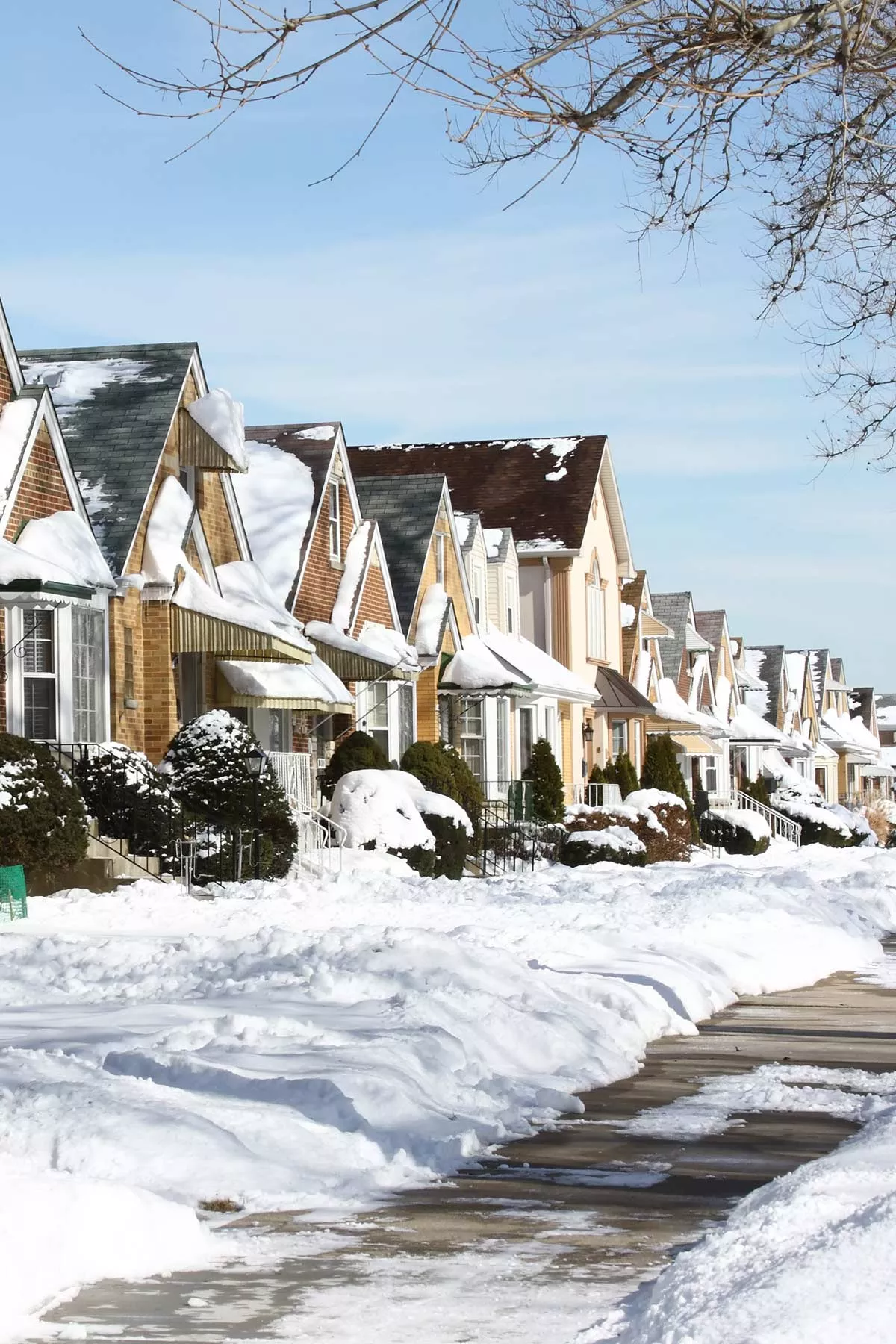
Let’s address the elephant in the room, shall we? Winters in Chicago are brutal and I guarantee that you will hate living in Chicago as soon as the temperatures dip below zero, the snow sets in and Lake Michigan freezes over. The perk of winter in Chicago? I swear it’s the sole reason housing prices are reasonable since most folks can’t commit to living in Chicago during winter. So I guess it’s not all bad?
I will also add that winter gets easier to manage after you live through one or two. You learn ways to cope, be it with expensive jackets or impromptu weekend trips to palm trees and paradise.
One thing I can’t recommend enough for folks moving to Chicago it to pick up one of these bad boys. My therapist recommended it ages ago to stave off depression during winter and I can’t imagine living in Chicago (especially during winter) without it.
#2. The Traffic Is A Nightmare
Make no mistake, traffic becomes a part of your daily routine when living in Chicago. In fact, Chicago’s infamous traffic is rated the third worst in the country, with drivers spending an average of 138 hours per year sitting in traffic.
You can expect trips to take 2-3 times longer during rush hour, which really starts to chip away at your quality of life, believe me (hence the reason I ditched my car and moved downtown). What’s more, even though Chicago has great public transportation, some folks can’t imagine getting rid of their car. If you find yourself in this camp, allocate a lot of time to traffic.
#3. Limited Access to Nature
Before the hate mail gets stamped, recall that I’m sharing my personal list of the cons of living in Chicago. Chicago doesn’t offer much by way of outdoor recreation. There, I said it.
I mean sure, we’re located on Lake Michigan, which is a treat, but lounging on the beach gets old after a time. Not to mention you can only do that a small portion of the year before the cold sets in. Don’t get me wrong, I enjoy Lake Michigan, North Avenue and Oak beaches as much as the next guy, but I need more variety.
There’s a handful of hiking options but they all require a drive and rarely live up to the effort required. In my opinion, limited access to nature is one of the biggest cons of living in Chicago. I will admit though, Millennium Park is one of the best urban parks I’ve ever come across.
#4. High Crime Rate
Chicago’s crime rate is a contentious topic. Half the residents will tell you it’s not as bad as the media portrays and the other half will tell you it’s still way too high for comfort. So let’s focus on facts and statistics instead. But fair warning — these stats are grizzly.
In 2018, there were 561 recorded homicides in Chicago, nearly double the number of New York City, which has triple the population. This doesn’t imply that the entire city is unsafe, rather there are certain pockets to avoid. You’ll need to do extensive research before moving to Chicago because crime is a factor.
Worth noting, I’ve been living in Chicago for 8+ years and haven’t had any scary encounters but I’m also hyper-vigilant and seldom hang downtown past midnight, especially solo.
#5. The Flat Landscape
I grew up around mountains and forests and I didn’t realize how much I’d miss a varied landscape until moving to Chicago. If you’re a nature nut, you’ll need to drive quite a distance (2+ days) to get into mountainous territory. For me, the flat landscape gets dull over time and I find myself clawing at the wall several times a year in desperate search of some varied terrain and serious nature.
Tell the next person the thing the guide misses.
Moving to Chicago (Post Summary)
In sum, these are the honest pros and cons of living in Chicago, Illinois.
- The people are kind
- The cost of living
- Cultural activities
- The food scene
- Chicago is diverse
- The airport
- Public transportation
- Housing costs
- The sports culture
- Chicago’s architecture
- The winters are harsh
- The traffic is a nightmare
- Limited access to nature
- High crime rate
- The landscape is flat
And there you have it my friends – a quick roundup of the pros and cons of living in Chicago. Don’t hesitate to reach out with questions or helpful comments for other readers.

Check Out Some More Perspectives From the Midwest
Best Neighborhoods Chicago: 10 Best Neighborhoods in Chicago
Living in Illinois: 15 Honest Pros & Cons of Living in Illinois
Living in Indiana: 15 Honest Pros & Cons of Living in Indiana
Living in Missouri: 15 Honest Pros & Cons of Living in Missouri
Living in Minnesota: 15 Honest Pros & Cons of Living in Minnesota
Living in Michigan: 15 Honest Pros & Cons of Living in Michigan
Living in Wisconsin: 15 Honest Pros & Cons of Living in Wisconsin
Living in Ohio: 15 Honest Pros & Cons of Living in Ohio
Living in Kentucky: 20 Honest Pros & Cons of Living in Kentucky
Living in Iowa: 15 Honest Pros & Cons of Living in Iowa
Living in Arkansas: 15 Honest Pros & Cons of Living in Arkansas
New Since Last Year
Update from The Honest Local, September 2026: everything from here down was added after the original local wrote this guide, with a source for each figure.
The murder count fell off a cliff. The city’s data portal counts 426 homicides in 2025, down 28% from 589 in 2024 (as of September 28, 2026). Shooting incidents fell 35% in 2025, by the police department’s year-end count, and carjackings fell by half, from 951 in 2024 to 479 in 2025, in the portal’s crime data.
Transit got rescued, and you’re paying for it at the register. Springfield passed a transit funding bill on October 31, 2025 that keeps the CTA, Metra and Pace running with no fare hikes or service cuts in 2026. The bill came with a 0.25% sales tax bump on August 1, 2026, so Chicago’s combined sales tax is now 10.50%.
INRIX’s scorecard released December 2025 had Chicago drivers losing 112 hours to congestion in 2025, first in the country and second in the world behind Istanbul.
Property tax bills went up again. The Cook County Treasurer’s August 2026 report showed residential bills up 5.34% for the 2025 tax year, the 32nd straight annual increase. The Chicago median rose a milder 2.2%, but some West Side neighborhoods saw bills double.
Two small wins for your wallet. The 1% grocery tax disappeared inside the city on January 1, 2026 (Illinois killed the state version and the City Council never replaced it), and the city minimum wage rose to $17.05 on July 1, 2026.
Rent is climbing faster than anywhere else in the Midwest. Apartment List’s July 2026 report put the median Chicago rent at $1,913, up 4.9% in a year while the national number slipped. Home values rose 5.2% in a year to $334,030 on Zillow’s city index, and the population ticked up for a third straight year, to 2,731,585.
Cost of Living in Chicago
Chicago runs about 4% pricier than the country as a whole, and housing is the biggest piece of it. That’s the Bureau of Economic Analysis reading for the metro in 2024, 103.6Price level (BEA price parity), the Bureau of Economic Analysis, 2024. Updates itself when the source does. against a national 100. Housing comes in at 112.0Housing (BEA price parity for housing services, priced from what tenants pay in rent), the Bureau of Economic Analysis, 2024. Updates itself when the source does. on the same scale, groceries and other goods at 107.3Goods prices (BEA price parity), the Bureau of Economic Analysis, 2024. Updates itself when the source does.. The MERIC index is a statewide number for Illinois, 94.5 in the second quarter of 2026, and it says more about Peoria than about a two bedroom in Logan Square.
Buying is where Chicago beats the country. Zillow’s typical home value inside the city limits is $334,030Typical home value, Zillow, August 2026. Chicago, IL (city). Updates itself when the source does. as of August 2026, against $368,697Typical home value, United States, Zillow, August 2026. Updates itself when the source does. nationally, so a Chicago house costs about 9% less than an American one. That’s the third biggest city in the country selling below the national average. The metro’s median asking price on realtor.com is $389,450Median listing price, realtor.com via FRED, September 2026. Updates itself when the source does., about 7% under the national $419,250Median listing price, United States, realtor.com via FRED, September 2026. Updates itself when the source does.. Values did climb 5.2% in the year to August while the national index rose 1.2%, so the discount is shrinking, but it’s still there.
Renting is where it doesn’t. Zillow’s typical Chicago rent is $2,342Typical rent, Zillow, August 2026. Chicago, IL (city). Updates itself when the source does. a month against $1,948Typical rent, United States, Zillow, August 2026. Updates itself when the source does. nationally, about 20% over, and it rose 5.8% in a year. The median renter here hands over 29.3% of their income to the landlord in the Census Bureau’s 2020 to 2024 survey, just under the 30% line where HUD calls you cost-burdened.
The rest of the bill. Gas is a real Chicago tax. Residential electricity ran 19.22 cents a kilowatt hour across Illinois in July 2026 against 18.31 nationally (EIA), about 5% more. Sales tax in the city is 10.50% since the August 2026 transit bump, though the city’s 1% grocery tax went away in January. Illinois income tax is a flat 4.95%Top state income tax rate, the Tax Foundation, 2026. Updates itself when the source does. with a single bracket, so there’s no marginal-rate math to do. Cook County’s effective rate runs about 1.9% of market value. The Census Bureau’s figure for homes inside the city is 1.48% of value, a median bill of $4,943 a year (2020 to 2024). The county number is roughly double the national average.
Cost of living by suburb, and where the city actually ends
Nobody in Chicagoland says “the suburbs” without a direction attached, and the direction is the price. The table is Zillow’s typical home value and typical rent for August 2026, the straight-line miles from State and Madison, and the Census Bureau’s July 2025 population against its 2020 base. Every suburb on this list inside 30 miles lost people in five years except Naperville.
| Place | Miles from the Loop | Typical home | Typical rent | Population 2025, change since 2020 |
|---|---|---|---|---|
| Chicago | 0 | $334,000 | $2,342 | 2,731,585 (-0.6%) |
| Cicero | 7 | $279,800 | $1,294 | 81,858 (-4.0%) |
| Oak Park | 8 | $486,900 | $2,025 | 52,823 (-3.6%) |
| Berwyn | 9 | $321,100 | $1,427 | 55,001 (-3.9%) |
| Evanston | 12 | $493,400 | $2,438 | 76,380 (-2.2%) |
| Skokie | 12 | $433,100 | $2,361 | 66,544 (-1.9%) |
| Oak Lawn | 13 | $301,000 | $1,744 | 56,450 (-3.2%) |
| Des Plaines | 18 | $358,500 | $2,058 | 58,772 (-3.1%) |
| Arlington Heights | 24 | $495,500 | $1,985 | 76,216 (-1.9%) |
| Schaumburg | 26 | $360,700 | $2,147 | 77,249 (-1.9%) |
| Naperville | 29 | $625,500 | $2,289 | 153,114 (+2.4%) |
| Aurora | 35 | $324,300 | $2,253 | 181,505 (+0.5%) |
| Plainfield | 36 | $429,300 | $3,019 | 50,043 (+11.5%) |
| Joliet | 37 | $269,600 | $1,668 | 152,241 (+1.2%) |
Read that table twice. Cicero and Berwyn sit seven and nine miles from the Loop, rent for about $1,000 a month less than the city and sell for less too, and they’re both shrinking. Oak Park is eight miles out and costs $150,000 more than Chicago. Plainfield grew 11.5% in five years and now rents for $3,019, the highest on the table. Joliet and Aurora are the two places on this list that are both cheaper than the city and growing.
Where to Live in Chicago, by Who You Are
Is Chicago a good place to live? Who should move here
Yes, for a specific kind of person. Judith, another transplant, made her peace with winter and traffic, if not with the flat part.
I’m also a transplant — from Southern California. I agree with you about the flat landscape. I want mountains. I’ve made my peace with winter by learning cross country skiing and snow shoeing. These activities get me outdoors and moving which keeps me warm and stave off cabin fever. I solve the traffic issue, like you, by living close to my job.
Judith Birgen, in the thread below, June 2022
Chicago in your 20s
The home values in this section are Zillow’s neighborhood index for August 2026, and the rents are Zillow’s index for the neighborhood’s main zip code in the same month, both rounded. The neighborhoods people your age name are the ones on a train line where a one bedroom doesn’t eat your whole paycheck. Logan Square on the Blue Line is the one everyone names first. Its typical home is $556,000, so you’ll be renting there, and the typical rent in its zip code is $2,339. Lake View on the Red and Brown Lines is $466,300 to buy and $2,527 to rent, and it has Wrigley Field in it, which tells you what summer sounds like there. Uptown, just north of it, is $342,100 and $2,018 for the same lake and the same train. Pilsen on the Pink Line is $440,300 and $1,867.
Melissa, who wrote in the thread below almost six years after moving here from New York, picked Lincoln Park on purpose because it sat in what she called a safe swathe with several el options, and it put her a mile from North Avenue Beach. Lincoln Park is $690,700 to buy and $2,866 to rent today, and she says herself it isn’t cheap, but her logic is the right logic for a newcomer. Pick the train first and the apartment second.
Families with kids
Families in Chicago sort themselves by whether they need a yard. Inside the city, Jefferson Park ($414,600), with a Blue Line and a Metra stop side by side, and Portage Park ($422,600) next door are the classic two. Edison Park ($482,000) and Norwood Park East ($433,300) are the corner of the city that feels like a suburb with a Chicago address. On the South Side, Beverly ($467,400) is the same idea with bigger lots and the Rock Island Metra line downtown. One mother of three in the thread says the good schools are only deep in the suburbs.
Over the line, the table above does the sorting for you. Oak Park ($486,900, eight miles out, Green Line and Metra) and Evanston ($493,400, Purple Line and Metra) are suburbs where you can still live without a car. Naperville, 153,114 people and the region’s best-known family suburb, is $625,500 a house, and it’s the only suburb on the table inside 30 miles that grew. If Naperville’s price is too much, Joliet ($269,600) and Aurora ($324,300) are cheaper than the city and still growing, 35 to 37 miles out.
Retirees
Retiring to Chicago sounds strange until you read the thread. Dom C. said last summer he was doing it this year, and his list is the guide’s Pros with a lakefront bike path added.
Good job and thanks for the review on Chicago. The additional data point is very helpful. Planning on retiring to Chicago with wife next year. Reasons include many of the ones you listed: friendly people and reasonable cost-of-living for a large city, varied and quality restaurants, easy access to major airport, world-class cultural offerings, and bicycling/hiking along the Lake. Two negatives are high property taxes and low appreciation of real estate values. Lived in 10 different places for work including SE Michigan, so we have experienced a similar cold winter climate.
Dom C., in the thread below, June 2025
His appreciation complaint is aging, with values up 5.2% this year. The neighborhoods that answer his list are the ones on the lake with a train. Edgewater ($282,400 to buy, $1,919 to rent) comes in well under the city’s typical home and puts you on the Red Line and the lakefront path, and Uptown ($342,100) is about at it. Lincoln Square ($525,500), off the lake, is the quiet one on the Brown Line.
Registered Nurse of 4 decades here. Although I’ve not lived in Chicago since the early 90s, (was there for a total of 14 years) I can state without qualification, it’s a top-notch/world class city in terms of medical care with research institutions , such Rush, Northwestern, & University of Chicago. I would not hesitate to live there again, especially in my ‘golden’ years. Best of luck!
Niles, replying to Sandy in the thread, January 2025
Remote workers
If nobody needs you in the Loop, you can skip the thing Chicago charges the most for, which is a short commute, and spend the difference on a neighborhood with a name and a main street. Andersonville ($625,700) and Ravenswood ($512,000) are the two everyone wants for that, and the prices show it. Albany Park ($397,500), Humboldt Park ($428,300) and Bridgeport ($444,600) get you the same kind of street for $180,000 to $230,000 less than Andersonville.
Great article, want nature? Try taking your bike on Metra to the west suburbs and enter the world of the Cook County Forest Preserves; miles of trails through woods along creeks and rivers. Varied hilly terrain? No need for 2 day travel, head to the hills of Galena and check.out the Eagle Festival in January; simply marvelous!
Margaret Schar, in the thread below, June 2022
Oak Park, Elmhurst and Downers Grove all sit on Metra’s west lines with forest preserve trails a bike ride away, and Downers Grove’s typical home is $509,200 against Oak Park’s $486,900 if you want the comparison.
Moving to Chicago, the Checklist
Every item here comes from an official page, linked at the end of it.
- Moving day itself. If a truck needs to sit on your street, your mover can pull a moving-van parking permit through CDOT’s online permit portal. The application asks for the mover’s ICC number and your dates, so book the mover first. (City of Chicago, CDOT permits and the moving van parking permit FAQ).
- Your driver’s license. You have 90 days to swap your old state’s license for an Illinois one, and if yours is valid you only take a vision test. It has to be done in person at a DMV, so book the appointment. Bring proof of your signature, your date of birth, your Social Security number and your new Illinois address. A REAL ID doesn’t transfer from another state, so if you want one you’ll need two documents proving your Illinois address plus proof of citizenship or lawful presence. The license itself is $30 if you’re 21 to 68, $5 if you’re 18 to 20 or 69 to 80. (Illinois Secretary of State, New to Illinois Driving and the driver’s license fees).
- Your car, at the state. Title and register it at the Secretary of State with the Application for Vehicle Transactions (VSD-190), your out-of-state title, the odometer reading, your Illinois address and the fees, which are $165 for the title and $151 a year for standard passenger plates. If a lender holds your title, a copy of it plus the loan agreement stands in for the original. A car that was titled and registered in another state for three months or more before you moved is exempt from Illinois tax, but you still file the Department of Revenue form saying so. Illinois verifies your liability insurance electronically at least twice a year under the Mandatory Insurance Law, so keep a policy on it from day one. In the Chicago area, most 1996 and newer gasoline cars get an emissions test once they’re four years old, even model years in even years and odd in odd, and diesels and electric cars are exempt. (Secretary of State facility checklist for new residents, vehicle fees, mandatory insurance, Illinois EPA emissions testing and the Illinois Air Team eligibility page).
- Your car, at the city. Chicago charges its own wheel tax, the City Vehicle Sticker, and you have 30 days from your move-in date to buy and display one. Miss it and the Clerk adds a $60 late fee plus prorated back months. (Office of the City Clerk, city vehicle stickers and the new resident FAQ).
- Income tax. Illinois taxes everyone at a flat 4.95%Top state income tax rate, the Tax Foundation, 2026. Updates itself when the source does., one bracket, and you’re a resident once Illinois is the place you live and intend to return to, which the Department of Revenue calls your domicile. File Form IL-1040 if you had to file a federal return, and Schedule NR for the part of the year you lived somewhere else. If you keep a job across the border in Iowa, Kentucky, Michigan or Wisconsin, Illinois taxes that paycheck and those states don’t, under reciprocal agreements. (Illinois Department of Revenue, who is an Illinois resident and filing requirements).
- Property tax, and the forms that save you money. Cook County assesses a home at 10% of its market value, multiplies by the state equalizer, subtracts your exemptions and applies the local rate. Every home is reassessed every three years, and the city’s last turn was 2024, when residential assessed values rose 18%. The Homeowner Exemption takes $10,000 off your equalized assessed value every year you own and occupy the place as your main home on January 1, it renews itself once you’ve filed, and you file online with the Assessor. The Senior Exemption takes another $8,000 off once you’re 65, renews the same way, and comes with the Homeowner Exemption built in. Both show up on the second-installment bill in the summer, so don’t panic when the first one arrives without them. (Cook County Assessor, your assessment notice and tax bill, the Homeowner Exemption, the Senior Exemption and the 2024 Chicago reassessment).
- Winter, the two rules that cost money. You shovel your own sidewalk, a path at least five feet wide, by 10 pm for snow that falls during the day and by 10 am for snow that falls overnight, seven days a week, or the fine is $50 to $500. And from December 1 to April 1, 107 miles of main streets are a tow zone from 3 am to 7 am whether or not it has snowed. The tow is $150 minimum plus a $60 ticket plus $25 a day in storage. Read the signs on your block before you sign the lease. (City of Chicago, sidewalk snow removal and winter snow parking restrictions).
- The el. Get a Ventra card before you need one. (CTA fares).
Chicago vs New York, Los Angeles and Denver
Price parity is the Bureau of Economic Analysis’s 2024 reading for each metro, home and rent are Zillow’s city figures for August 2026, and the income tax is each state’s top rate for 2026.
| City | Prices vs US (100) | Housing vs US (100) | Typical home | Typical rent | Top state income tax |
|---|---|---|---|---|---|
| Chicago | 103.6 | 112.0 | $334,000 | $2,342 | 4.95% |
| New York | 112.6 | 148.6 | $822,500 | $4,154 | 10.9% |
| Los Angeles | 113.6 | 170.4 | $929,600 | $2,778 | 13.3% |
| Denver | 105.8 | 146.9 | $524,700 | $1,881 | 4.4% |
The BEA columns are 2024 price levels across the whole metro, the second one for housing, and Zillow’s are what a lease inside city limits costs this summer, so the two can disagree, and on Denver they do.
A New York house is about 2.5 times a Chicago house and the rent is 77% higher, $4,154 against $2,342, for a city that the BEA says costs 9 points more across the board. Denver is the one that surprises people.
Against the Midwest, the story flips. Chicago is the expensive one. Against Illinois as a whole, a Chicago house costs 12% more than the state’s typical $297,600.
Questions people ask about Chicago
What do I need to do when I move to Chicago?
Swap your license within 90 days, and if your old one is valid you only take a vision test. Title and register the car at the Secretary of State, $165 for the title and $151 a year for plates, and buy the city’s vehicle sticker within 30 days of moving in. File the Homeowner Exemption with the Cook County Assessor the first winter you own a place. The checklist above has the documents, the winter parking rules and the links.
Is Chicago cheaper than New York, Los Angeles and Denver?
Yes, on housing, by a lot. A New York house runs about 2.5 times a Chicago house and its rent is 77% higher. On the BEA’s 2024 price parities Chicago sits at 103.6 against New York’s 112.6, Los Angeles’s 113.6 and Denver’s 105.8. Against Milwaukee, Indianapolis and Minneapolis, Chicago is the expensive one.
Where in Chicago should I live?
In your 20s, pick the train first, then the apartment. Logan Square, Lake View, Uptown, Pilsen and Rogers Park are the neighborhoods people your age name, and Rogers Park is the cheapest of them on the lake. Families lean to Portage Park, Jefferson Park, Edison Park and Beverly inside the city, or Oak Park, Evanston and Naperville over the line. Retirees want the lake and a Red Line stop, so Edgewater, Uptown or Hyde Park. The section above has the August 2026 home value for every one of them.
Figures marked with a dotted line update themselves from Zillow, realtor.com via FRED, the Bureau of Economic Analysis and the Tax Foundation. Last checked October 8, 2026.
Locals split hard on this one. Longtime residents and transplants who love the jobs, the food, and the lake often say the pros outweigh the cons, while others who grew up there or moved away say they can’t stand the crime, the cold, or the people trying to sell them something.
The recurring warning is winter, described as brutal, biting cold with wind that cuts like a pizza slicer downtown, though a few argue it’s no worse than New York or Boston. Cost and safety also come up again and again as reasons people leave.
The surprise for newcomers is that Chicago isn’t the flat, nature-starved place the guide suggests. Locals point to Cook County Forest Preserves reachable by Metra, Starved Rock, and the hilly getaway of Galena with its January Eagle Festival.
“It's a mixed bag, to be sure, but the pros outweigh the cons for us.”
Melissa Local · 6 years
“When you get hit with wind cutting your face like a pizza slicer downtown, running door to door because of the ice, that is brutal.”
Actual Illinoisan Reader
“Great article, want nature? Try taking your bike on Metra to the west suburbs and enter the world of the Cook County Forest Preserves”
Margaret Schar Reader